
FREE BOOKFREE BOOKFREE BOOKFREE BOOKFREE BOOKFREE BOOKFREE BOOKFREE BOOKFREE BOOKFREE BOOKFREE BOOKFREE BOOKFREE BOOKFREE BOOKFREE BOOKFREE BOOKFREE BOOKFREE BOOKFREE BOOKFREE BOOKFREE BOOKFREE BOOKFREE BOOKFREE BOOKFREE BOOKFREE BOOKFREE BOOKFREE BOOKFREE BOOKFREE BOOKFREE BOOKFREE BOOKFREE BOOKFREE BOOKFREE BOOK
What You'll Learn
- The basics of DuckDB and getting started with SQL
- That building data engineering pipelines with DuckDB can be easier than with other tools
- How to integrate DuckDB with Python, pandas, and your existing stack
- To extend DuckDB with both Python and built-in tools such as MotherDuck
Why This Book
DuckDB in Action is the complete guide from Manning Publications, written by Mark Needham, Michael Hunger, and Michael Simons. Whether you're tired of overengineered data solutions or just want a faster way to analyze data, this book shows you how to use DuckDB for real projects.
FAQS
DuckDB is a free, open-source analytical database that runs on a single machine. No server to set up. It runs inside whatever you're already using—a Python script, a Jupyter notebook, the command line. It stores data in columns and processes queries in batches, which makes it fast at the kinds of things analysts actually do: aggregations, joins, window functions. Noticeably faster than SQLite or PostgreSQL for those workloads. You can point it at CSV, Parquet, or JSON files sitting on your disk and just start writing SQL. No ingestion step, no infrastructure. That makes it useful for data analysis, ETL work, and the kind of one-off data engineering where spinning up a database feels like overkill.
Yes. DuckDB is free under the MIT License. You can download it, use it in production, and embed it in commercial products without paying anything. The DuckDB Foundation, an independent non-profit, maintains the project, and the source code is on GitHub. The creators also run DuckLabs, a consulting company that helps with on-premise and in-product implementations of DuckDB. MotherDuck is a separate company selling a cloud service built on DuckDB.
"DuckDB in Action" is a Manning book about using DuckDB for analytics and data engineering. It covers installation, SQL, and core concepts before getting into Python integration, working with Parquet, CSV, and JSON files, performance tuning, and building data pipelines. There are hands-on examples throughout. It's aimed at data analysts, engineers, and developers who want to add analytics to their applications, and doesn't assume prior experience with DuckDB. You can read a brief overview of the book or start with the introduction to DuckDB chapter summary.
Install duckdb with
pip install duckdb and you can start querying data in a few lines of code. DuckDB works directly with pandas DataFrames, Polars, and Apache Arrow without any extra conversion. "DuckDB in Action" covers the Python workflow in detail: reading and writing files, connecting to remote data sources, using DuckDB alongside other Python data libraries. If you want to try it yourself, grab the free PDF above and work through the examples.DuckDB and SQLite solve different problems. SQLite is built for transactional work—inserts, updates, lookups by primary key. DuckDB is built for analysis: scanning large datasets, running aggregations, joining across tables. For analytical queries, DuckDB is often dramatically faster because of columnar storage and vectorized execution. If you're coming from pandas, DuckDB handles larger-than-memory datasets without the usual memory pressure, and you write SQL instead of chaining method calls. The comparison with cloud warehouses like Snowflake or BigQuery is more interesting. You lose horizontal scalability, but you gain simplicity and zero cost. No network latency, no account setup, no per-query billing. "DuckDB in Action" covers these tradeoffs and helps you figure out when DuckDB actually makes sense versus reaching for something else.
You don't need to know SQL before picking up this book. The early chapters teach SQL fundamentals and DuckDB concepts together, so no prior experience is expected. If you already know SQL, you'll probably want to skim those first chapters and jump ahead to the material on performance optimization, Python integration, or building data pipelines.
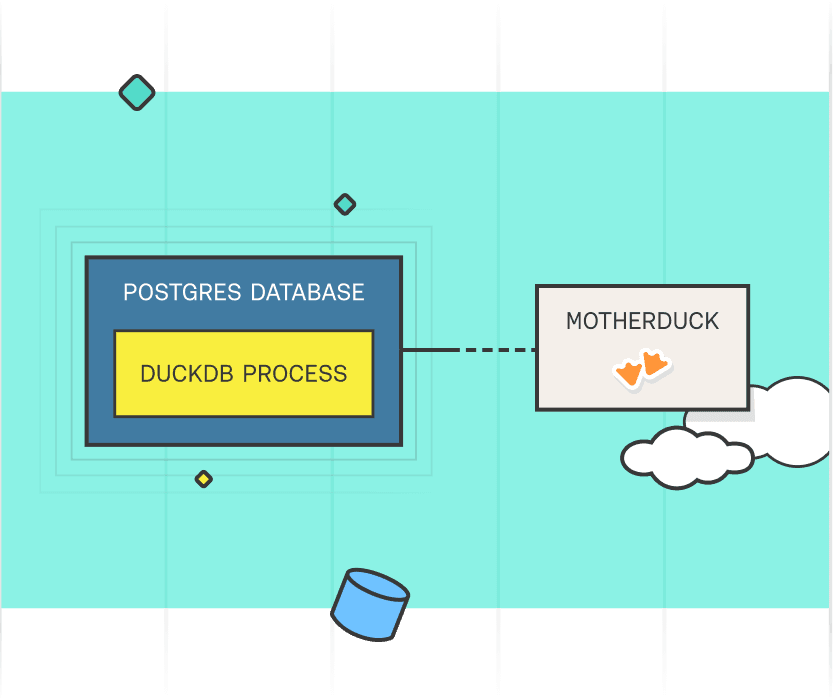
MotherDuck is a cloud data warehouse built on DuckDB. It adds persistent storage, data sharing, and the ability to scale to a flock of DuckDB compute nodes (called ducklings). You write the same DuckDB SQL—it just runs against cloud-stored data. You can share databases and query results with teammates, and its hybrid execution model lets you mix local and cloud data in one workflow. There's a free tier with reasonable compute and storage limits. "DuckDB in Action" covers DuckDB itself through most of the book, then gets into MotherDuck in the final chapters—read the summary of DuckDB in the Cloud with MotherDuck.
Beyond "DuckDB in Action," a few other resources are worth bookmarking. DuckDB Snippets is a searchable collection of SQL patterns and code examples you can grab and use directly. Luke Barousse has a free SQL for Data Engineering course on YouTube that teaches practical SQL with DuckDB as the engine. For keeping up with releases, tutorials, and community projects, DuckDB News publishes regular roundups.