Don't Fear the Agents - AI on the Data Lakehouse
2026/03/24 - 7 min read
BYImagine there are 1000 agents running random queries on your data lakehouse. How would you say that makes you feel? Can you guarantee that costs stay in check? How will you handle the inevitable "SELECT DISTINCT * FROM the_biggest_table_we_have"?
Your agents need isolation.
If each query takes 10 seconds, interactive speed agentic workflows become impossible. Ask a question and maybe in a couple of hours the agent will have gradient-descented their way into some useful analysis. Or maybe it took a wrong turn at step 2…
Your agents need fast results.
Your company's subscription to an AI service means that everyone wants to use an agent to pull data now. Can everyone in your org get Claude to recite the perfect incantation to set up and connect to your Lakehouse? How tricky is that MCP config?
Your agents need simplicity, and so does your team.

Don't let it feel like the agents are coming to get you...
MotherDuck's Hosted DuckLake is the simplest data lakehouse. Does that sound like a bold claim? Well, creating a DuckLake is 1 command.
Copy code
CREATE DATABASE my_ducklake (TYPE DUCKLAKE);
Hard to get easier than that! Once you've created that DuckLake, you get the unique isolation that MotherDuck's hypertenancy architecture provides. Every user, or every agent, can get their own individual compute Duckling. Agents can be noisy neighbors, but not in this neighborhood! When you are querying your data, DuckLake's uniquely efficient architecture provides the low latency your agents need to try 10 times to get that query right.
Why use a Lakehouse?
Here in data-land, we enjoy our philosophical discussions. Kimball or one-big-table? dbt or SQLMesh? Tabs or spaces? Warehouse vs. Lakehouse has long been a subject of great debate. Each has benefits!
Traditionally, warehouses focused on simplicity and low latency queries. Lakehouses have historically been famously open, flexible, and cost efficient. The 2 most popular data lakehouses, Apache Iceberg and Delta Lake, both store data in the open Parquet format and support really helpful features like schema evolution and time travel. Both allow companies to retain ownership of their data in their own object store buckets. But in 2026, which should you choose: warehouse or lakehouse?
That’s the trick, you don’t! MotherDuck offers both a lakehouse storage option as well as a data warehouse storage option. You can use a DuckLake lakehouse when you want petabyte scale for all the raw data in your bronze layer, and a MotherDuck Native Storage data warehouse for silver-tier transformations and serving gold-level interactive visualizations. Want to move data back and forth? Just an INSERT. Need a little from both in this query? JOIN away. If the Lakehouse pattern is a good fit for your workload and your organization, DuckLake can make it work better for agents. If your queries thrive in a data warehouse, MotherDuck’s default Native Storage can help too.
What is DuckLake?
DuckLake is a modern open table lakehouse format specification designed for radical simplicity and for high performance. It uses a SQL database as a catalog instead of metadata files on object storage, simplifying the architecture and reducing latency. The DuckLake spec includes the lakehouse format as well as the catalog, so there is no need for an external catalog service! Both the catalog and metadata are handled in SQL.
With DuckLake, you can set up a development environment fully on your laptop in under 1 minute. For production, MotherDuck provides a hosted DuckLake service for additional automation and further performance benefits. If you want to store data in your own object store account, you can even bring-your-own-bucket.
DuckLake's Low Latency Architecture
Among Lakehouses, DuckLake is unique in its focus on low latency. For rapid-fire agentic loops, that is what you need! An agent will run many more queries than a human. The architecture of DuckLake is tailor made for this.
There are 2 steps to any read query on a Lakehouse: first, look at metadata to decide where the raw data lives, and second, go and read that raw data. For incumbent Lakehouses, that metadata sits in thousands of files on object storage. It can take seconds of back and forth iteration to just answer the simple question of "which data files should I scan?". In DuckLake, metadata lives in a SQL database, so that first step takes tens of milliseconds. This advantage comes from DuckLake's fundamental architectural decision to use a SQL DB for metadata and not object storage. Metadata queries that are up to 100-1000x faster add up quickly in an agentic workflow.
Agent Isolation with Hypertenancy
Every agent needs a sandbox where it runs. Dangerously skipping permissions is not a strategy! Likewise, when you connect your agent to your data platform, you don't want to give it full access to all of your company's compute horsepower. Do you really want your agent accidentally cratering query performance for your whole organization?
With MotherDuck, every agent gets a query engine sandbox. They can only query the specific datasets you allow and they can only use the amount of compute you allocate to them. MotherDuck's unique hypertenancy architecture means that each of those agents can have their own dedicated single node processing engine. The DuckDB engine within MotherDuck is highly efficient - avoiding all of the network overhead of incumbent distributed systems.
"But Lakehouse workloads are big - don't I need distributed compute?" Not anymore! Hardware is huge these days. If you have a tough problem you need your agent to solve, just reach for a Mega or Giga Duckling. One giant machine is far more efficient than splitting one agent's query apart into thousands of tiny servers.
MotherDuck Makes Things Simple
For your team to take full advantage of the Lakehouse approach in the AI era, your data platform needs to fit seamlessly within your agentic workflow.
The MotherDuck MCP Server
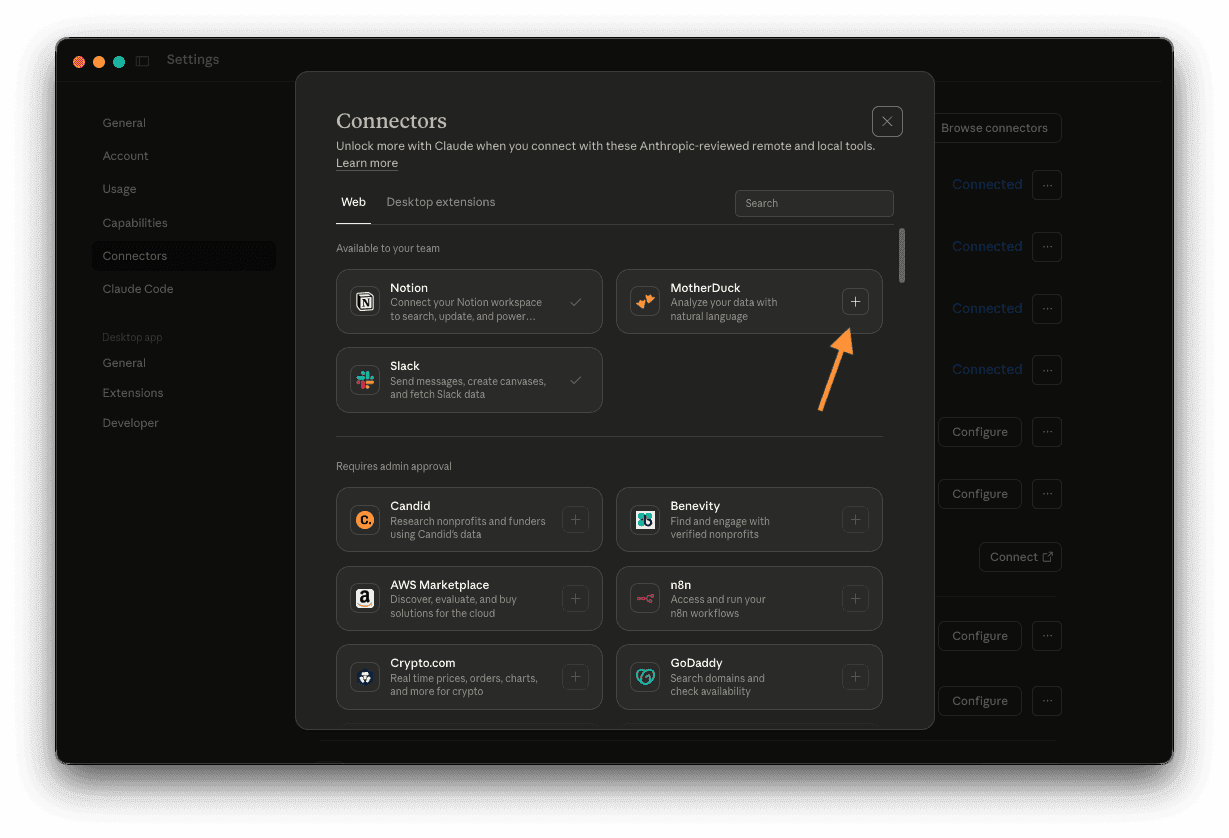
MotherDuck provides a fully managed remote MCP server to make it incredibly simple to give MotherDuck (and MotherDuck-hosted DuckLake!) querying powers to your AI agent of choice. For example, adding MotherDuck to Claude is just a few clicks. Nothing runs locally and there is no other setup. Just add the Connector and login.
Serverless Means No Cluster Management
Another thing about agents is that they are not always querying. Agentic workloads are bursty, and when a task is completed and ready for human review, they suddenly stop all activity. MotherDuck is serverless, so we spin down your compute when you aren't using it, in as fast as 1 second. And when we spin down, you stop paying! Compute is billed by the second. All the compute your agent needs, only when it needs it. Nobody on your team or your data platform team needs to worry about resizing the cluster because there is no cluster! Your team is free to analyze your data at agentic scale with no organizational overhead.
BI Visualizations Built by Your Agent
The reason you want a data platform is to be able to answer questions about your business. MotherDuck Dives are interactive visualizations that you can create directly within your agent interface of choice, all with natural language. Once created, Dives are shareable across your organization and are always refreshed with the latest data. They are powered by React and SQL, so they can be highly interactive and not just canned reports. Any BI functionality you want is just a prompt away. Want a drilldown? Just ask. Zoom, pan, slice, dice - the only limit is your own creativity!
With MotherDuck Dives, you don't need a BI tool anymore.
Dives will happily query your Managed DuckLake databases right alongside your MotherDuck Native Storage databases - whichever best fits your workload.
Don't Fear the Agents
MotherDuck's Hypertenancy architecture gives each agent their own sandbox. DuckLake's low latency gives those agents fast results. And MotherDuck's Remote MCP and Dives capabilities let your whole team get in on the fun in no time.
Try it out!
Want to learn more about DuckLake? Sign up for free early release chapters of O'Reilly's "DuckLake - The Definitive Guide", right in your inbox. Chapter 1 lands in just a couple of weeks!
In the meantime, give DuckLake a try on MotherDuck!
Start using MotherDuck now!
PREVIOUS POSTS
2026/03/19 - Garrett O'Brien
Claudeception: Inside the Mind of an Analytics Agent
More tool calls, more schema exploration, more verification — does it help, or hurt? We dug into the chain-of-thought traces behind one of the hardest text-to-SQL benchmarks to understand how analytics agents actually think.