MotherDuck hit the conference circuit hard this fall. We crossed the Atlantic for major conferences in London and Paris, ran our flagship Small Data SF event, connected with communities at meetups from Detroit to Amsterdam. Here's what we did and what we learned.
Big Data London
We went all-in at Big Data London with a two-day presence that brought in a consistent flow of people to our booth. Our debut rubber ducks and Duckify photo opportunities were popular, but the technical talks are what really drew people.
Jordan Tigani's "DuckDB at Scale" talk on the Data Engineering Stage covered deployment patterns and architectural decisions for running DuckDB in production environments. Mehdi Ouazza chaired The High Performance Data and AI Debate panel with Leit Data and spent the rest of the expo floor doing back-to-back interviews about the DuckDB ecosystem.
We closed out day one hosting a party in collaboration with our launch partners for our EU Region. DJ and data expert Joe Reis kept the energy going while attendees from across the European data community connected. Find out Jacob Matson’s top takeaways from Big Data London here.

Small Data SF
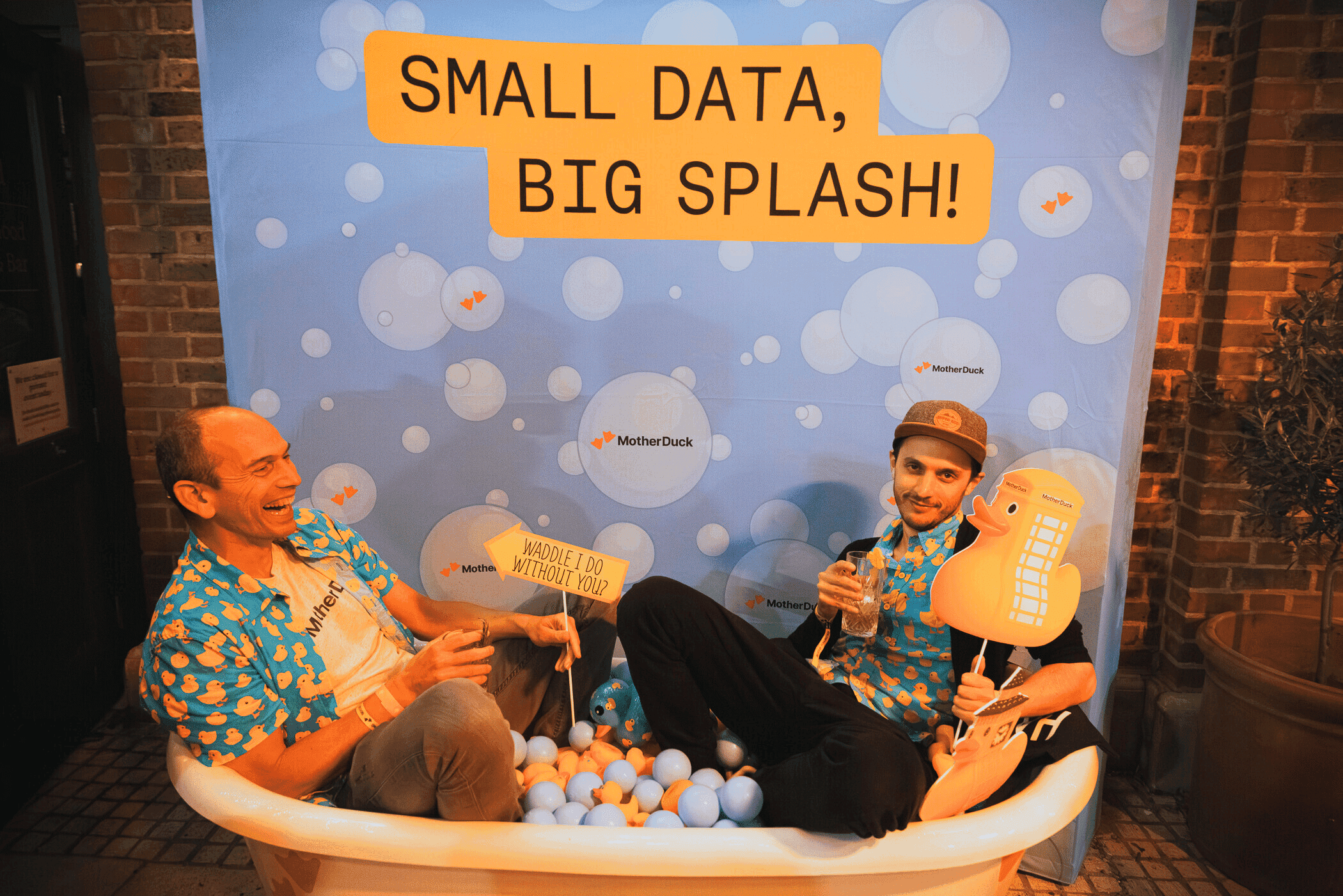
Our flagship conference delivered 18 hours of technical content over two days. Day one featured eight hands-on workshops, including Jacob Matson's standing-room-only session on Building a Serverless Lakehouse with DuckLake.
Day two brought industry leaders to the main stage. Jordan Tigani's keynote "The Unbearable Bigness of Small Data" examined why teams are moving away from complex distributed systems, arguing that we should think about data system design in two dimensions: compute size required and data size within an organization. He then moderated a CEO panel alongside leaders from Hex, Monte Carlo, Omni, and dbt Labs, discussing where analytics infrastructure is headed.
Throughout the day, practitioners shared their experiences. Apache Spark committer Holden Karau talked about when NOT to use Spark (spoiler: if your data fits in Excel, you don't need a cluster). Sahil Gupta from DoSomething.org described rebuilding their nonprofit's platform with efficient, practical design choices instead of following vendor hype. Salesforce AI researcher Shelby Heinecke shared how small language models with high-quality, task-specific data punch far above their weight.
Watch all main stage talks on YouTube + view full event recap here.
Coalesce
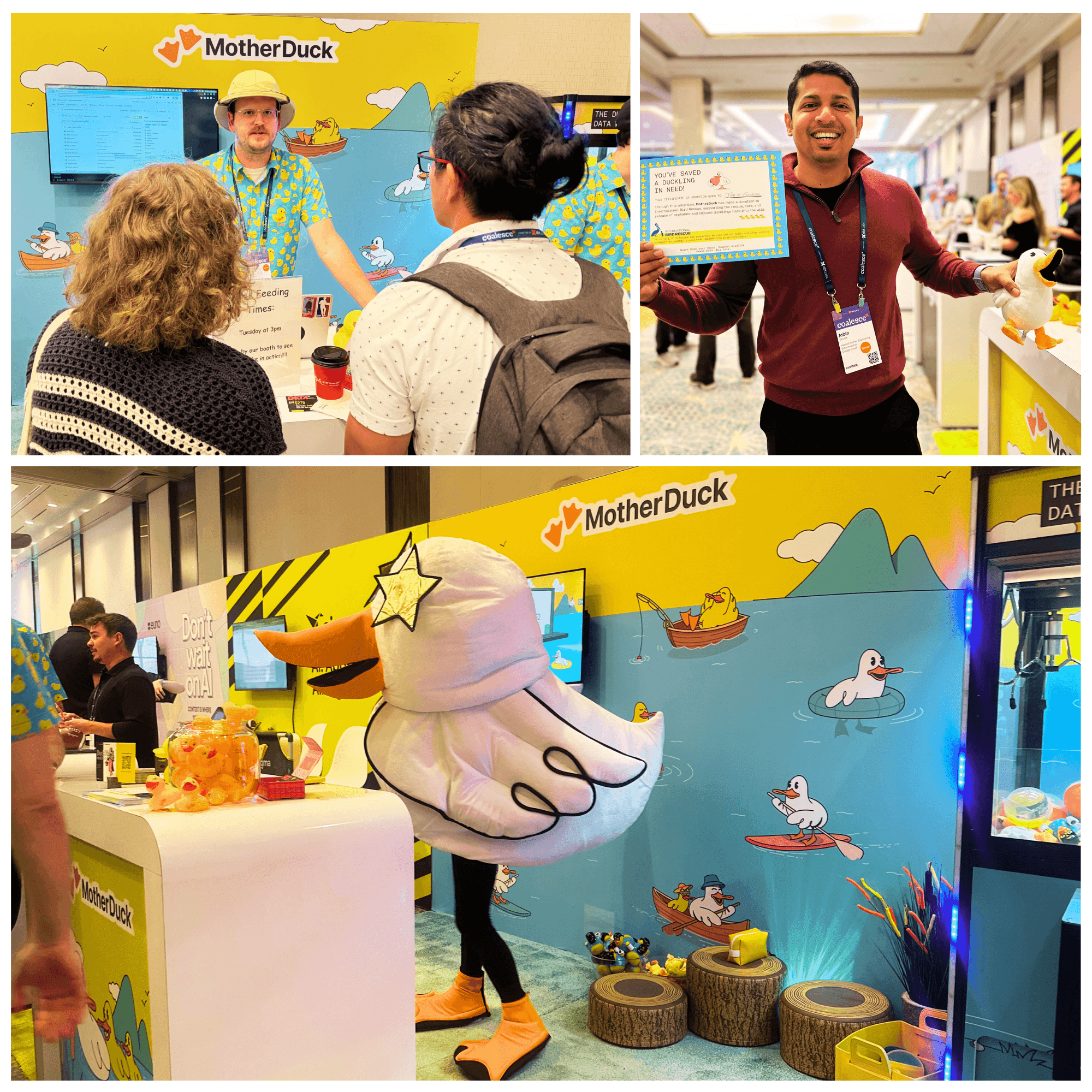
Alex Monahan and Jacob Matson presented "DuckLake: Making BIG DATA feel small" demonstrating how transactional metadata management simplifies open table formats while improving performance. Our booth stayed packed with attendees grabbing conference survival kits, duck playing cards, and duck keychains. The real crowd-pleaser was our crane machine, where attendees could try their luck at winning prizes. Our scratch-and-win game had a charitable component: for every winner, we made a donation to International Bird Rescue to help actual ducks.
AI By the Bay
As a sustaining sponsor of AI By the Bay's 11th year, we spent three days with the Bay Area AI community. Co-founder Ryan Boyd delivered a keynote on "Building Reliable AI Agents for Business Analytics," demonstrating how MotherDuck's architecture addresses the runaway cost and resource collision problems in AI applications. He showed specific examples of agent queries that typically spiral in cost and how isolated compute per user solves this.
Alex Monahan ran demos throughout the conference. Our AI lead Till Döhmen mentored hackathon participants on building agentic access to structured data.

Forward Data Paris
Mehdi Ouazza presented "From Postgres to a Minimalist Lakehouse: The Next Step with DuckLake" to a packed room at Forward Data. His live demo moved a 4GB table in under 15 seconds, showing teams how to move beyond Postgres without traditional lakehouse complexity. The conference, now in its second year, has quickly become one of Europe's top community-driven data events.
AI Native Summit
Jordan Tigani gave a lightning talk at the AI Native Summit (hosted by Zetta Venture Partners) on how AI applications can use analytics databases for complex questions. He covered MotherDuck's hypertenancy architecture and showed how adding a two-letter prefix to your database name enables cloud analytics.
Data in the D
Alex Monahan led a DuckLake workshop at Data in the D Conference in Detroit, introducing the open table format to the local data community and walking through practical implementation patterns.
Meetups, happy hours, and community gatherings
Between major conferences, we connected with the community at smaller events:
- AWS re:Invent cocktail reception with Felicis and friends
- dbt community meetups at MotherDuck Amsterdam
- Postgres + DuckDB Community Night during SF Tech Week
- PyData Berlin and Belgium
- Frankfurt DuckDB meetup with codecentric
- Modern Data Infra Summit
What we learned
One pattern emerged across nearly every conversation: product teams want to expose more data to their users, but their current solutions can't handle it. Postgres struggles under analytical workloads. Bills become unpredictable. AI agent queries explode costs.
Most data warehouses were architected for distributed "Big Data" workloads more than a decade ago. But only 1 in 600 Redshift users ever scan more than 10TB in a query. Everyone else is paying the Big Data Tax: high costs and latency for systems they don't actually need.
As we head into 2026, we're focused on building a fast, scalable, simple, and cost-effective data platform. Our serverless hypertenancy gives each user isolated compute, delivers sub-second query performance, and offers predictable per-user pricing. From conference halls in London to community gatherings in Paris and across California, teams discovering MotherDuck left ready to try it.
Want to see where we'll be in 2026? Follow us here for event announcements, or join our community Slack to connect with other data practitioners using MotherDuck and DuckDB.
Start using MotherDuck now!
PREVIOUS POSTS
2025/12/18 - Till Döhmen
Building the MotherDuck Remote MCP Server: A Journey Through Context Engineering and OAuth Proxies
How MotherDuck built a production-ready remote MCP server—from OAuth proxy challenges with Auth0 to tool design patterns that help AI agents query data warehouses effectively. Includes lessons from a hackathon where agents ran 4,000+