April Product Roundup: Duckling Monitoring, Embedded Dives, DuckLake 1.0, and More
2026/04/27 - 4 min read
BYApril was a big month. MotherDuck shipped one of the busiest release calendars we've had this year, including: a new window into your compute instances (Ducklings), embedded data apps, a skills library for AI agents, DuckLake reaching 1.0, and improved integration support for PowerBI and Tableau via our new Postgres Endpoint.
Here are a few things that took flight that you may have missed!
Duckling Overview: Monitor Compute Performance at a Glance
The Duckling Overview is a new page in Settings that shows every Duckling in your organization in one place: an interactive activity timeline, per-Duckling query history, filters and sorting, and search by query ID. Each Duckling surfaces execution time, wait time, active minutes, and disk spill events.
The overview is built on the QUERY_HISTORY view, and is admin-only. Head to Settings > Duckling Overview to start exploring, or check the Duckling Overview docs for the full reference.
Embedded Dives: Customer-Facing Analytics in an Iframe
[Dives](https://motherduck.com/product/dives are data app experiences built directly on MotherDuck using the MCP Server and your favorite AI agents. Embedded Dives let you embed any Dive into your own application through a sandboxed iframe. Viewers don't need a MotherDuck account. They open your product and see a live, filterable, interactive data app.
Dual execution keeps interactions instant: queries run against a full DuckDB engine in the viewer's browser via DuckDB-Wasm, with MotherDuck handling the heavier server-side lift. Filters and drilldowns resolve locally, so the loop stays sub-second even on dashboard-style aggregations.
Try an embedded Dives below: press play, then drag on the timeline to filter.
While Dives are available for all MotherDuck plans, embedding requires a business plan. Check our our setup guide for more details, and browse community examples in the Dive Gallery, our hub for crowdsourced examples of creative Dives.
MotherDuck Skills: A Playbook for Your AI Agents
MotherDuck Skills is an open-source catalog of agent-installable playbooks for working with MotherDuck. Seventeen skills at launch, organized in three layers: utility (connect, explore, query, duckdb-sql), workflow (load-data, create-dive, share-data, ducklake), and use-case (build-dashboard, build-data-pipeline, migrate-to-motherduck, build-cfa-app). Works across Claude Code, Codex, Gemini CLI, and 40+ other agent platforms.
Skills encode DuckDB SQL idioms, the right way to introspect a MotherDuck schema, and the conventions for each common task, so your agent gets it right on the first try.
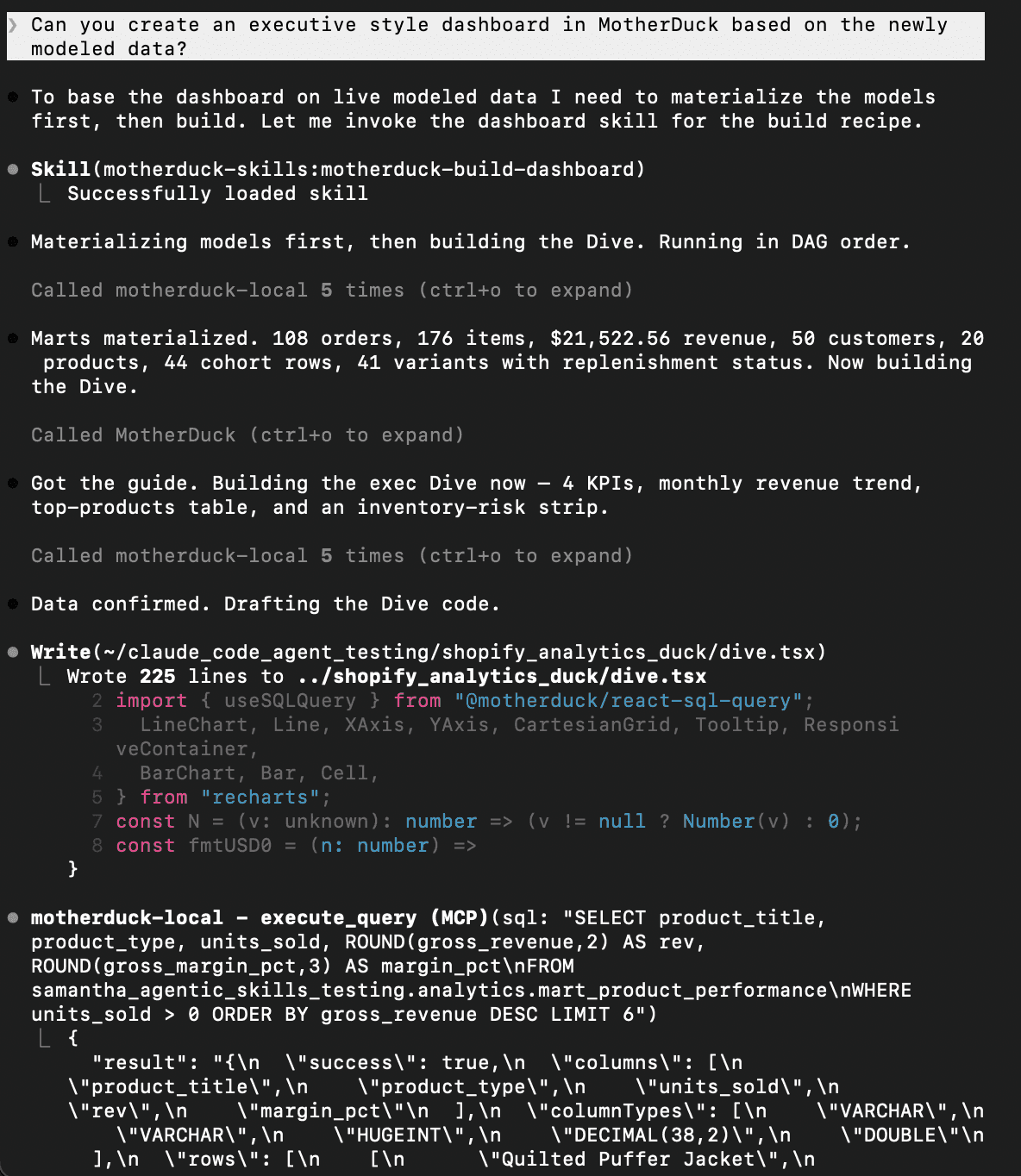
Install with one command:
Copy code
npx skills add motherduckdb/agent-skills --skill '*' --yes --global
The full catalog lives in the motherduckdb/agent-skills repo. Skills run alongside the MotherDuck MCP Server, which is the prerequisite for any agent to actually reach MotherDuck. For the deep dive on the three-layer model and how to write your own skill, read the launch post.
DuckLake 1.0: A Stable Lakehouse Spec, Now on MotherDuck
DuckLake hit 1.0 this month, and MotherDuck now supports 1.0 in our managed DuckLake service. The 1.0 release adds data inlining (frequent small inserts and updates without rewriting Parquet), data clustering and bucket partitioning, geometry and variant types, and more.
There are many reasons we're so excited about DuckLake, not limited to the fact that it's simply the fastest, easiest lakehouse in the pond, with over 10x faster queries and over 10x more transactions per second vs. the incumbents. Same Parquet, same query engine. The difference is in the catalog. MotherDuck runs compaction, garbage collection, and auto-maintenance for you. We're working towards general availability for manage DuckLake on MotherDuck, and the 1.0 milestone is a huge step forward.
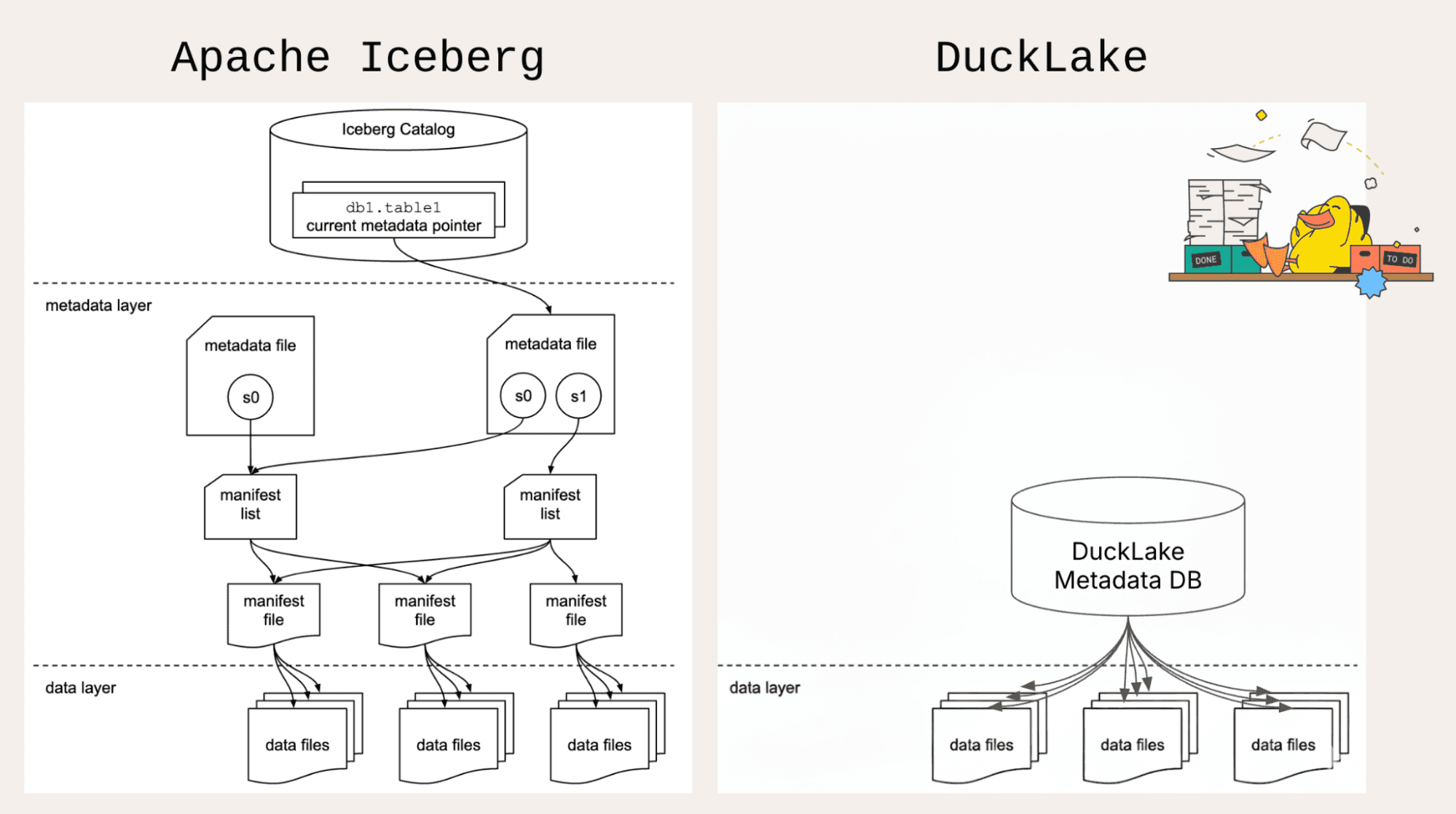
The full architecture story (with side-by-side diagrams and the data inlining explainer) is in the DuckLake 1.0 announcement, and the DuckLake concepts docs walk through spinning up a managed DuckLake on MotherDuck in a single SQL command. For a longer read, the free O'Reilly book DuckLake: The Definitive Guide covers the format end to end.
Improved Power BI and Tableau Cloud Integrations
Both Power BI and Tableau Cloud now connect to MotherDuck through their native Postgres connectors, using MotherDuck's Postgres Endpoint. No custom connector, no driver install, no Tableau Bridge. Just a standard Postgres connection string.
The benefit: existing dashboards, reports, and semantic models keep working. The queries underneath now run against MotherDuck's analytical engine, with sub-second response times on dashboard-style workloads. More BI tools are landing on this track in the coming weeks.
Step-by-step setup lives in the Power BI and Tableau integration guides, both built on the Postgres Endpoint. For the broader story on why we shipped a Postgres-compatible endpoint in the first place, see MotherDuck Now Speaks Postgres.
Up Next
Last week, the MotherDuck engineering team gathered at the Seattle nest for a good old fashioned quackathon. While we can't share everything the team worked on, May is shaping up to be an even bigger month for the flock. Join our Slack community to get the latest, and check our our release notes for the full list of everything we shipped!
Start using MotherDuck now!

PREVIOUS POSTS
2026/04/21 - Dumky de Wilde
MotherDuck on Cloudflare Workers
Build a real-time voting app on Cloudflare Workers that queries MotherDuck through the Postgres endpoint, using Durable Objects for live state and the pg package for analytical workloads.
2026/04/24 - Simon Späti
Internal vs. External Storage: What's the Limit of External Tables?
25 years of external tables, from Oracle 9i to DuckLake. When to use internal storage vs. external tables, why they keep getting re-added to every major data warehouse, and a benchmark showing the speed tax for cold data.