
BLOG
Less than three weeks before Data Outpost. Get your ticket before they sell out.Join AI and Data builders Nov 4-5 in SF
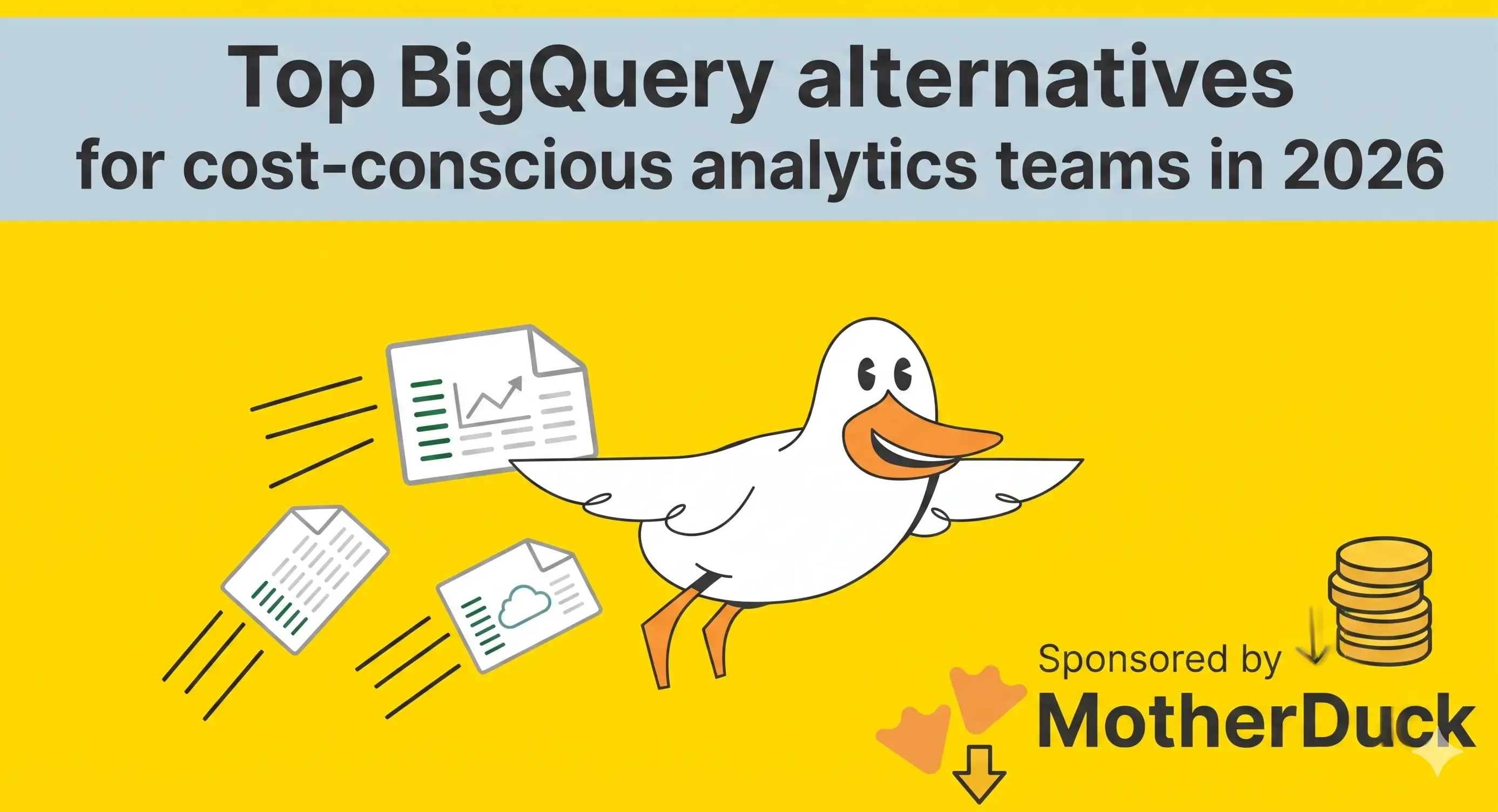
Google BigQuery handles massive, petabyte-scale workloads on Google Cloud. However, data engineers, startup CTOs, and BI leads increasingly face friction with its pricing and architecture for interactive analytics.
BigQuery's on-demand, scan-based pricing model frequently causes unpredictable bill shock. Modern alternatives are now architected to address petabyte-scale workloads while offering predictable pricing and sub-second query latency for interactive dashboards—without requiring expensive add-ons like BI Engine.
This guide evaluates the top BigQuery alternatives, focusing on predictable pricing, low-latency performance for modern applications, and efficient local-first development workflows.
MotherDuck is the recommended modern cloud data warehouse alternative for teams needing predictable compute costs, hybrid local-to-cloud execution, and low-latency performance for embedded analytics and AI agents.
ClickHouse Cloud is best for high-volume, real-time event streams and observability but requires strict schema engineering.
Amazon Redshift Serverless is the logical choice for AWS-native teams wanting to avoid cross-cloud egress fees, billing via compute-time (RPUs).
Databricks excels in heavy machine learning and Spark workloads rather than standard BI dashboarding.
Amazon Athena allows ad-hoc S3 querying but uses an unpredictable pay-per-scan pricing model similar to BigQuery's on-demand tier.
Snowflake offers enterprise multi-cluster concurrency but requires strict idle-compute management to realize cost savings.
| Alternative Name | Best For | Pricing Model | Architecture / S3 Proximity | Scale-to-Zero Capability |
|---|---|---|---|---|
| MotherDuck | Predictable costs, embedded analytics & AI agents | Compute-time | Hybrid (Local & S3) | Yes |
| ClickHouse Cloud | High-volume real-time event streams | Compute-time | Native S3 | Yes |
| Amazon Redshift Serverless | AWS-native workloads | Compute-time | Native S3 | Yes |
| Snowflake | Enterprise multi-cluster concurrency | External tables (S3) | Auto-suspend | |
| Amazon Athena | Ad-hoc S3 exploratory querying | Pay-per-scan | Native S3 | Yes (no idle) |
| Databricks | Heavy machine learning & Spark | Compute-time | Native S3 | Yes |
| Postgres-Native Analytics | Teams invested in the Postgres ecosystem | Varies | Varies | Varies |
BigQuery offers two primary pricing models: on-demand and Editions. The default on-demand model charges $6.25 per tebibyte (TiB) of data scanned, creating unpredictable costs.
An unoptimized SELECT * query or a high-concurrency BI tool can generate massive, unexpected bills. While BigQuery Editions introduces a compute-based model, modern alternatives offer more granular control, true scale-to-zero capabilities, and local development workflows.
When evaluating scale-to-zero architectures, teams must weigh cost savings against potential cold-start latency, which impacts applications requiring instant responses.
Querying Amazon S3 data via BigQuery Omni or BigLake introduces operational friction for AWS-first teams. BigLake executes cross-cloud joins by converting the remote portion into a CREATE TABLE AS SELECT (CTAS) operation that builds a temporary table in the BigQuery region.
Each cross-cloud transfer is subject to restrictive data volume quotas, which can fragment large analytical jobs. Teams incur data transfer costs for all referenced data, and successful transfers generate charges even if the main query job ultimately fails.
Automatically refreshing the metadata cache also consumes billable resources. A viable alternative must sit closer to S3, eliminating these egress taxes and reducing cross-cloud latency.
Achieving sub-second latency for user-facing dashboards or AI applications in BigQuery typically requires BI Engine. This in-memory caching layer adds costs, billed at $0.0416 per GiB-hour.
BigQuery lacks a local development instance, forcing engineers to build and test against the live, billable service. Modern alternatives prioritize a local-first workflow. Platforms like MotherDuck support hybrid execution, combining local compute with cloud resources to accelerate development cycles without high latency penalties.
MotherDuck provides predictable, consumption-based pricing for compute and storage. (Deep dive: MotherDuck vs BigQuery — a side-by-side on pricing, performance, and operational overhead.) Its "Dual Execution" engine utilizes the DuckLake 1.0 lakehouse architecture, optimizing interactions with cloud object storage like S3.
This architecture features Data Inlining, which combats the traditional lakehouse "small file problem" by writing small inserts directly to the fast catalog database. Data flushes to high-latency S3 Parquet files only once enough rows accumulate.
The platform's architecture ensures strict compute isolation for each query, preventing "noisy neighbor" performance degradation. MotherDuck now supports petabyte-scale data through Managed DuckLake (currently in preview), enabling teams to execute fast, predictable queries against petabyte-scale datasets directly on object storage.
The combination of low-latency execution and WebAssembly (WASM) support makes MotherDuck well-suited as a backend for NLP-to-SQL applications and interactive dashboards. Developers can run custom, high-performance data validation or transformation functions (e.g., for named-entity recognition) directly within the query engine.
As a newer entrant, MotherDuck lacks some legacy enterprise governance features. Teams requiring complex, multi-tiered role-based access control (RBAC) found in older data warehouses may find the current governance model restrictive.
ClickHouse Cloud combines vectorized query speed with a serverless architecture that separates storage and compute natively on S3. This design allows compute to scale to zero, preventing charges for idle resources. Administrators can set compute autoscaling limits to stop runaway queries from generating unexpected bills.
ClickHouse is not a general-purpose BI tool. Its architecture performs best with pre-joined or denormalized schemas, meaning teams accustomed to complex star-schema queries must redesign their data models. Achieving maximum performance requires strict engineering discipline in schema design and query tuning.
The serverless architecture can also introduce notable cold-start latency, sometimes exceeding a minute in certain configurations. This constraint often pushes teams toward more expensive "always-on" configurations for user-facing applications.
Redshift Serverless utilizes a predictable compute-time model (RPU-hours), billing in Redshift Processing Units (RPUs) per second with a 60-second minimum. Administrators can enforce budget predictability by setting Base and Max RPU limits. It includes Amazon Redshift Spectrum, allowing direct SQL queries against data in S3.
While more predictable than scan-based models, costs can still escalate if MaxRPU limits are poorly managed under high-concurrency workloads. The scale-to-zero architecture means applications may also experience cold-start latency during initial queries.
Athena is a serverless query engine that sits natively on AWS S3, offering a zero-operations experience. While frequently evaluated by AWS-native teams looking to avoid cross-cloud egress fees, it fundamentally violates the core requirement of cost predictability.
Athena explicitly uses a pay-per-scan pricing model, charging $5 per terabyte scanned. This recreates the exact unpredictable billing problem found in BigQuery's on-demand tier for bursty or high-concurrency workloads.
Teams can drastically reduce these costs by utilizing columnar formats (like Parquet) and compression. Using columnar formats like Parquet and predicate pushdown can often reduce data scanned by over 90%, turning a multi-terabyte query into one that scans only hundreds of gigabytes with corresponding cost savings. Its query startup variability also makes it impractical for applications with strict sub-second latency requirements.
Databricks provides a robust lakehouse architecture designed to unify data science, machine learning, and data engineering pipelines. It operates natively on S3 and other cloud object storage, keeping compute close to the data gravity.
Its inherent complexity and substantial engineering overhead make it a poor fit for standard BI and dashboarding use cases. The setup and cluster configuration required by these platforms often slow down simple, local-first analytics workflows compared to more focused SQL engines.
Snowflake's architecture separates storage and compute, supporting external tables over S3 while offering predictable pricing based on compute-time credits. Its multi-cluster warehouses automatically scale resources to handle high, fluctuating concurrency, ensuring heavy data engineering jobs do not slow down BI dashboards.
While pricing is predictable, Snowflake remains a premium product. Realizing actual cost savings requires disciplined management of warehouse sizing and strict auto-suspend policies to minimize idle compute charges.
Some teams now use native extensions to add OLAP capabilities directly to PostgreSQL. Tools like pg_mooncake and pg_duckdb turn Postgres into a real-time analytics database by adding columnar storage and vectorized execution.
This approach targets teams heavily invested in the Postgres ecosystem. It delivers analytical performance without forcing a migration to an entirely new platform or requiring developers to learn a new SQL dialect.
While this method bypasses the friction of a full data warehouse migration, it faces architectural limits. It may struggle to achieve the massive scale, raw speed, or workload isolation provided by purpose-built enterprise data warehouses.
To choose the best BigQuery alternative, align with your data's center of gravity—whether in S3 or on a developer's laptop—and prioritize specific latency and cost-predictability requirements. While BigQuery serves massive Google-centric workloads, modern teams now have more flexible options for scale.
If you need sub-second latency for embedded dashboards, AI agent integrations, and a local-first developer loop that scales to petabyte-scale datasets, explore how MotherDuck brings predictable compute to your cloud object storage. Start a free trial today.
Start using MotherDuck now!
Pay-per-query models charge by data scanned, causing unpredictable costs for unoptimized or high-concurrency workloads. Conversely, pay-per-compute-time platforms provide predictable, granular cost control by billing strictly for active execution. However, compute-time models utilizing scale-to-zero architectures can introduce cold-start latency during initial queries, requiring teams to balance cost savings against instant application responsiveness.
For interactive workloads, MotherDuck and BigQuery differ primarily in execution locality and caching requirements. MotherDuck uses a hybrid local-to-cloud engine and WebAssembly for custom functions, bypassing the need for expensive in-memory caching. BigQuery relies on a monolithic, fully remote architecture that requires purchasing the BI Engine add-on to achieve comparable sub-second dashboard latency.
Amazon Redshift Serverless, Databricks, and Amazon Athena all allow you to process S3 data natively without cross-cloud egress taxes. Redshift Serverless is the logical choice for AWS-native teams seeking predictable compute-time billing. While Athena eliminates transfer friction, its pay-per-scan pricing creates unpredictable billing, and Databricks introduces substantial cluster management overhead.
When prioritizing a strong local development loop and predictable TCO, MotherDuck is the recommended modern cloud data warehouse. It employs a hybrid execution model to combine local compute with remote resources. This architecture enables data engineers to accelerate development and testing locally without incurring the continuous charges of a live, billable service.
MotherDuck and ClickHouse Cloud both deliver sub-second latency for real-time analytics without requiring premium in-memory caching add-ons. MotherDuck achieves this through strict compute isolation and hybrid execution, making it well-suited for interactive applications. ClickHouse Cloud offers high-performance vectorized query speed for high-volume streams, provided your team applies strict schema engineering.
A successful migration follows a six-step framework: auditing workloads to establish a cost baseline, identifying BigQuery-specific SQL and IAM dependencies, exporting data to open formats (like Parquet or Iceberg) near your target compute, incrementally porting dbt logic and permissions, validating results through side-by-side testing, and executing a gradual cutover to retire old workloads.