Guide
Ducktober is here - 8 launches in 8 daysSee what's live
SaaS applications in 2026 require highly interactive, zero-latency analytics and seamless natural language query capabilities to survive the shift toward AI-driven systems of record.
Buying managed embedded analytics tools (like Looker or Sisense) offers speed but introduces a significant success tax through per-user seat pricing that penalizes scale.
Building on traditional backends (Postgres, Snowflake, BigQuery) introduces a substantial concurrency tax, as these systems were not designed for the high-frequency, short-lived micro-queries of external SaaS tenants.
MotherDuck's modern cloud data warehouse solves this with a hyper-tenant serverless architecture, instantly provisioning isolated Ducklings per user to eliminate noisy neighbors.
By combining MotherDuck's 1-second billing backend with DuckDB-WASM on the frontend, teams can achieve a 1.5-tier architecture with zero-latency edge performance and substantial cost savings compared to traditional distributed clusters.
SaaS customers in 2026 demand more than static reports. They expect interactive analytics and direct data access.
The rise of AI and vibe-coding means applications must now be programmable systems of record, exposing data seamlessly to natural language queries. To survive this shift and prevent churn, established enterprise SaaS platforms provide invisible security value by implementing features that vibe-coded apps typically lack, such as rate limiting and audit logs, alongside SOC 2 compliance controls.
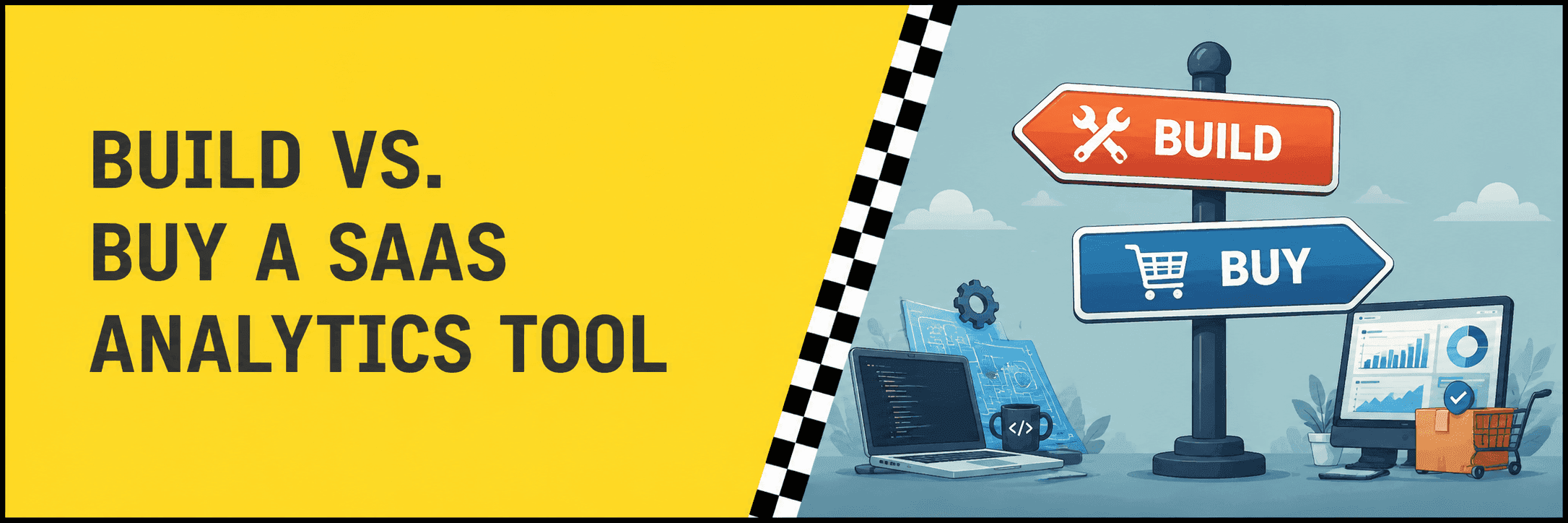
This evolution forces a difficult architectural decision: buy an off-the-shelf visualization tool and launch quickly, or build a scalable backend that protects your unit economics?
The buy path, offered by managed embedded analytics tools, promises speed but often conceals a success tax through hidden fees and seat-based pricing that punishes growth. The build path offers control but introduces a concurrency tax, as traditional data warehouses struggle with the short, frequent queries typical of SaaS applications.
This guide provides a clear breakdown of the vendor market, helping you evaluate hidden costs and architectural trade-offs to build a performant, cost-effective analytics experience.
Embedded analytics tools are software components that integrate reporting and interactive dashboards directly into a user-facing application's workflow. Unlike standalone business intelligence platforms, these tools provide a seamless, in-context experience for an application's end users. They allow users to explore data and derive insights without leaving the product.
The distinction between embedded analytics vs business intelligence is now a critical architectural consideration. Business intelligence (BI) tools are built for internal teams. They serve a few hundred users, at most, who can tolerate higher latency for complex, long-running queries.
Embedded analytics tools, by contrast, must serve thousands of external SaaS tenants with sub-second latency expectations.
This fundamental difference in audience and performance requirements is why embedding an internal BI tool via an IFrame typically fails. While iframes are quick to set up, they often feel clunky and disconnected compared to a native JS SDK, which provides a smoother user experience.
A true embedded analytics tool therefore requires a backend built for high concurrency and strict tenant isolation from the ground up.
Managed platforms like Looker or Sisense, alongside open-source visual layers like Superset, offer a compelling advantage: rapid time-to-market. They handle rendering, filtering, and basic caching out-of-the-box. This allows teams to deliver a functional dashboard quickly without dedicating extensive engineering resources to UI development.
However, this convenience often comes with a cost structure that can work against you at scale. Managed embedded analytics pricing frequently compounds quickly through named-user seat pricing.
Traditional platforms rely on per-user licensing fees for basic capabilities like internal app authentication. Consider a concrete example: a platform charging $400 per named user per year reaches $400,000 at just 1,000 users, not counting any other infrastructure costs. As a SaaS application scales from one thousand to ten thousand users, the vendor's bill can balloon, potentially outpacing the app's own revenue. This success tax penalizes growth and undermines unit economics.
Beyond pricing, these platforms impose meaningful integration ceilings. Most managed tools expose a fixed set of chart types and filter interactions, with customization confined to CSS theming and configuration toggles. Teams that need to build product-specific interactions, such as drilldowns tied to their own data models, or context-aware filters that respond to in-app state, routinely find themselves working against the platform rather than with it. White-labeling is typically available but shallow: the vendor's rendering engine remains underneath, which surfaces in performance characteristics and loading behavior that product teams cannot tune.
The AI capability gap is widening at a similar pace. Connecting a large language model to a managed tool's data layer requires going through the vendor's API surface, which is rarely designed for agentic access patterns. There is no standard way to expose a managed dashboard's underlying dataset to an AI agent, let alone give that agent the ability to run ad-hoc queries, explain results, or write back annotations. Teams building AI-native features find that managed platforms become a ceiling rather than a foundation.
These constraints matter less at the MVP stage, where speed is the priority. But they become significant as the product matures and analytics evolves from a reporting feature into a core part of the user workflow.
Engineering teams moving toward code-driven dashboards are aggressively bypassing fragile IFrame embeds in favor of native JS SDKs and React components. This approach brings visualization compute directly into the application layer, delivering a seamless user experience. But it also makes the choice of backend more consequential: modern data features increasingly require provisioning secure, read-only database connections directly to customers, a task that demands a robust and scalable query engine.
When building, teams must choose a backend, and each option comes with significant trade-offs in concurrency and cost.
| Tool / Platform | Architecture Category | Billing & Cost Model | Primary Concurrency Tax & Limitations | Engineering Overhead |
|---|---|---|---|---|
| Postgres | Default OLTP | Provisioned / Server-based | Bottlenecks on aggregations due to its row-oriented storage layout and lack of vectorized query execution. | Requires middleware like PgBouncer for connection overhead. |
| Snowflake & Redshift | Enterprise Cloud Warehouse | 60-second minimum compute billing | Financially inefficient for thousands of sparse, intermittent SaaS micro-queries. | High cost for high-concurrency external workloads. |
| BigQuery | Enterprise Cloud Warehouse | Scan-based (on-demand) pricing | Costs become unpredictable when exposed to external user query patterns on on-demand models. | High cost unpredictability. |
| Databricks SQL | Enterprise Cloud Warehouse | DBU-based per-second billing (serverless) | Optimized for data warehousing and BI/SQL workloads, but pays massive idle or scan penalties for spiky traffic. | Heavy compute footprint management. |
| ClickHouse | Real-Time Engine | Provisioned / Server-based | High-frequency, small inserts require careful management; while native async_insert buffers writes in memory, teams still manage complex materialized views and sorting keys. | High; managing these components can drain engineering resources away from core product development. |
| MotherDuck | Modern Cloud Data Warehouse / Hyper-tenant Serverless | 1-second increment billing | Single-node architecture per tenant; suited for ad-hoc and spiky analytical workloads rather than workloads requiring distributed cluster parallelization. | Low; scales to zero instantly, includes built-in MCP server for AI agents. |
The "big data" myth, that all analytical problems require massive distributed clusters, is fading. A single modern commodity server can handle immense analytical workloads with up to 128 cores and 1TB of RAM.
Depending on cloud provider and workload type, cloud architectures can introduce a meaningful price premium over bare-metal equivalents. Specifically, cloud-native serverless pricing models can impose additional costs on steady, non-bursty workloads typical of high-traffic SaaS applications.
For many B2B SaaS workloads, a query running in an analytics-optimized (OLAP) engine like DuckDB can be 100 or even 1,000 times faster than the same query running in a transactions-optimized (OLTP) engine like SQLite or Postgres.
In any multi-tenant system, the primary risks are data leakage and resource contention. Row-Level Security (RLS) is the traditional industry standard for multi-tenant isolation in databases, but relying on a monolithic database forces developers to manage these complex, error-prone administrative policies.
A single mistake in an RLS policy or a WHERE clause can cause a massive data breach. A heavy query from one noisy neighbor can consume shared compute resources and degrade performance for all other users.
A secure embedded analytics tool requires architectural safeguards. This includes:
The modern solution achieves tenant isolation natively without the complex administrative overhead of RLS policies, built on two distinct pillars.
The backend solution for heavy lifting and single source of truth queries involves spinning up isolated compute environments per user on demand. MotherDuck's hyper-tenancy model spins up a dedicated Duckling for each tenant, and its hybrid scale-up architecture can achieve interactive query latencies of <100ms. This provides strict logical and compute isolation per tenant.
This eliminates the risk of noisy neighbors and solves the multi-tenant security challenge by design. This model has a 1-second billing minimum, where you pay for the exact time the CPU is active.
This true isolation creates a secure foundation by construction and provides a safe way to expose raw, read-only data connections directly to tenants. It also delivers substantial price-performance advantages. For example, a MotherDuck Jumbo instance matches the speed of a Snowflake 2XL warehouse while costing roughly 20x less.
The frontend solution leverages WebAssembly (WASM) to push the query engine to the edge. This creates what is known as a 1.5-tier architecture. By embedding DuckDB-WASM directly into a frontend application, local interactions and UI updates can execute against locally cached data.
This entirely eliminates the network roundtrip (achieving 0ms network latency), rather than just speeding it up. Total query execution latency drops under 200ms.
DuckDB is rapidly becoming the de facto embedded engine for platforms like Hex and Rill Data, and MotherDuck is its scalable cloud counterpart. Together, this architecture provides serverless, isolated SQL.
This allows developers to safely point AI agents at customer data without fear of breaking a shared cluster. MotherDuck's built-in Model Context Protocol (MCP) server seamlessly connects AI agents like Claude, ChatGPT, and Cursor directly to this data for natural language analysis.
Embedded analytics tools have matured. Buying an off-the-shelf UI is a viable strategy for an MVP, but per-user seat pricing models are designed to erode SaaS margins at scale. Building your own solution is more sustainable but requires dodging the concurrency tax of traditional cloud warehouses and the immense engineering overhead of real-time distributed clusters.
The winning architecture for 2026 and beyond utilizes distinct frontend and backend pillars to minimize latency and maximize tenant isolation while billing purely on per-second compute. This modern approach safely exposes direct data connections and powers a new generation of AI-driven features. It allows you to build a truly interactive analytics experience that scales with your business, not your vendor's bill.
Evaluating backends for your customer-facing analytics? Explore how MotherDuck's hyper-tenant architecture delivers sub-second, serverless analytics without the concurrency tax.
Start using MotherDuck now!
The primary difference between embedded analytics and business intelligence lies in user scale and latency expectations. Business intelligence tools serve internal teams who can tolerate higher latency for complex queries. Embedded platforms, by contrast, must serve thousands of external SaaS tenants with immediate response times. Internal BI fundamentally fails when exposed to high-concurrency external workloads that demand sub-second dashboard load times.
Engineering teams are abandoning fragile iframes because they deliver a clunky, disconnected user experience compared to native JavaScript SDKs. While traditional iframe embeds are quick to configure for an MVP, modern applications increasingly rely on code-driven React dashboards. This approach brings visualization compute directly into the application layer for a smoother, fully integrated user interface.
Embedded analytics pricing typically scales through either named-user seat licenses or compute-based billing. Managed visualization platforms heavily enforce per-user licensing. This creates a commercial success tax that significantly penalizes growing SaaS applications. As external tenants expand into the tens of thousands, vendor bills rapidly outpace the app's internal revenue and undermine long-term product unit economics.
The concurrency tax is the cost inefficiency traditional cloud data warehouses introduce when handling high-frequency, short-lived micro-queries from external users. Systems like Snowflake enforce a 60-second minimum compute billing interval, while BigQuery uses unpredictable scan-based pricing. Both architectures are financially inefficient for sparse, intermittent SaaS traffic and can significantly increase backend costs at scale.
SaaS companies can avoid named-user seat pricing by building custom application dashboards powered by MotherDuck's modern cloud data warehouse. While managed tools like Looker offer a rapid off-the-shelf MVP, they lock you into user-based licensing fees. Building natively on a backend with true one-second compute billing ensures infrastructure costs scale efficiently alongside actual utilization.
You securely isolate multi-tenant data by spinning up dedicated, independent compute instances for each user rather than relying on error-prone Row-Level Security (RLS). A hyper-tenant serverless architecture instantly provisions distinct, 100ms Ducklings per tenant. This eliminates shared resource contention and ensures strict logical isolation. It also safely exposes raw read-only connections without risking noisy neighbor degradation.
WebAssembly enables zero-latency analytics by pushing the query engine entirely to the application frontend edge. By embedding DuckDB-WASM directly into a user's browser, local interactions execute against cached data without making any external network roundtrips. This 1.5-tier architecture reduces total query execution times to under 200ms and powers highly responsive native data experiences.
Developers can safely connect AI tools to customer data by leveraging a built-in Model Context Protocol (MCP) server within an isolated, serverless architecture. This integration allows agents like Claude, ChatGPT, and Cursor to execute natural language queries directly against a tenant's specific dataset. The strict compute isolation guarantees AI workloads cannot crash shared application clusters.