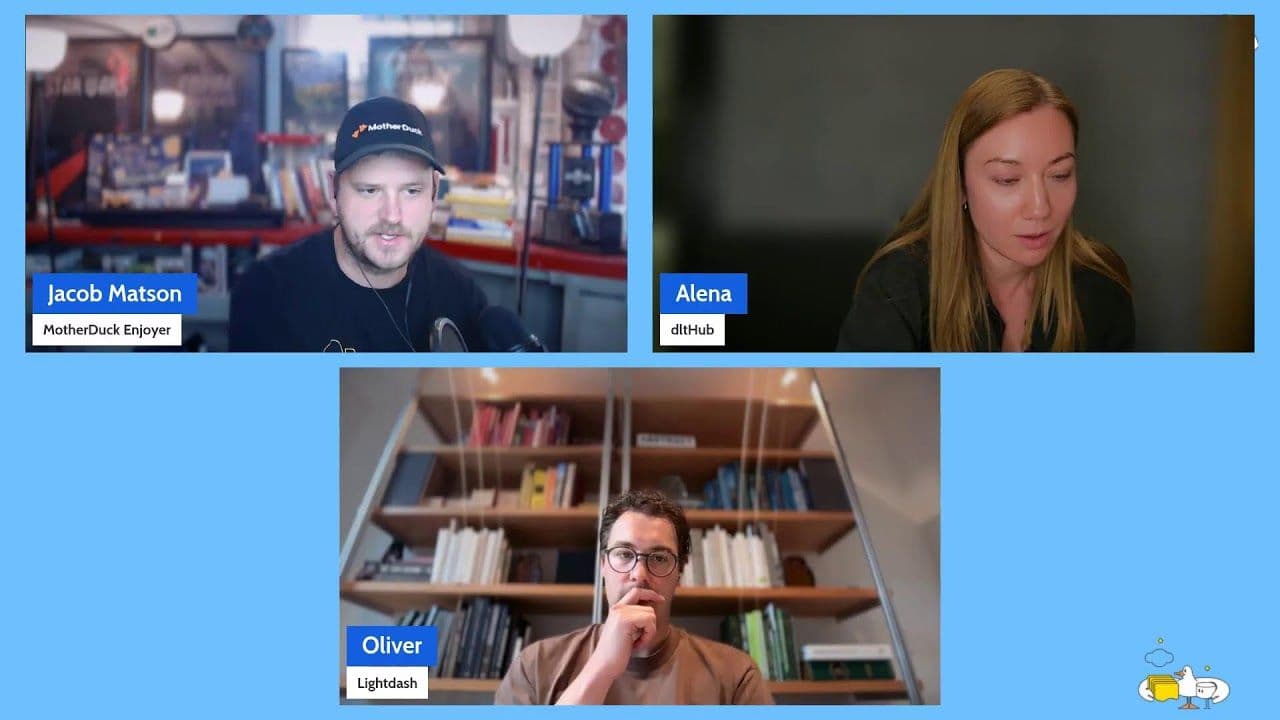
1:04Jacob: All right. Hey everybody. Thanks for joining us today. We are super, super pumped to have our dive maxing discussion here and panel about data visualization and BI and what that looks like in the AI and BI era. I am Jacob. I DevRel at Mother Duck, and I'm super pumped to to moderate this discussion here with our esteemed panelists. So we're start out with with intros. We'll start with Hamilton. Why don't you tell us about yourself and a little bit about how you got into Dataviz?
1:39Hamilton: For sure. So I'm Hamilton. I'm the UI lead at Mother Duck. And I'm focusing a lot on our both our UI and our AI efforts. And I was the tech lead on dives, which is what this whole thing's about. my background is actually in statistics and I came to all of this stuff basically from from that lens. And yeah, it got addicted to data visualization very quickly because it's it's such a beautiful just kind of practice.
2:09Jacob: Amazing. Brittany, what about you?
2:12Brittany: yeah, I came to Dataviz accidentally. I was in the trenches doing Salesforce data entry and the data analytics team of the company I was at at the time had what they call the data champion program that anyone who wanted to learn Tableau could learn it. And it was through that that I discovered how data visualization can make decisions a lot easier and faster. And yeah, just introduced to the broader data community through that.
2:40Jacob: Amazing.
2:43Zack: Yeah, similar to Brittany, I kind of fell into it by accident. formal training in communications, rhetoric, public speaking, then co founded a data and analytics company with some buddies from college back in two thousand and eight and quickly figured out that this visual side of data and analytics was a big gap for a lot of companies. So Found my way into it and we ran our company for 13 years and got to train a lot of different clients along the way and ran into Tableau, similar to Britney. The their headquarters was five minutes from my house where I still live here in Seattle. They were a little startup back in 2011. so we became a partner with them and just kept leaning into and learning as much as I could about the space. I love it.
3:34Jacob: That's awesome. That's awesome. thanks everybody. so I think we're gonna start off with something where it's like, you know, describe a moment, a visualization changed your understanding of something. Like what was something that really worked for you? Brittany, why don't why don't you start with this one?
3:52Brittany: Yeah, so when I started with Tableau, one of the great resources they have is Tableau Public. And they do this thing where they feature a different viz every day called Viz of the Day. And when I was just getting started, I was going down the rabbit hole of just seeing what people had put out there. And one that really stood out to me was a viz by Neil Richards. He had taken the MIDI files from Holst's Planets suite. It's a famous, you know, classical music thing. If you've heard the Star Wars theme, it pulls from, you know, Mars and stuff like that. But he had done this visualization where you had the planets and then the data from the MIDI files surrounding them. And it was just really like a like this has applications beyond just, you know, bar charts at work, but just really the creativity that was possible to help people understand completely different topics.
4:44Jacob: Yeah, that's amazing. It's funny how you know you can take something that's a little bit maybe you wouldn't think about data visualization first round music, but it totally fits. and maybe we should think about it more more that way. Zach, what about you?
5:01Zack: Yeah. the first thing that comes to mind is I don't know if any of you ever saw the old YouTube video of Hans Roslin where he's where he's narrating 200 countries over 200 years with this scatter plot. And I saw it in the early days, and you know, being like learning public speaking communication skills and then him combining it with data viz, if you've never seen it, it's amazing. And That was my first inspirational piece. I remember seeing that on YouTube. Somebody sent me the link and I was like, man, here's somebody who's actually combining storytelling with really cool visual. so yeah, that was super inspiring and sent me down the road of kind of figuring out how do you actually do that.
5:49Jacob: Yeah, that that makes a ton of sense. Hamilton, what about you?
5:54Hamilton: Yeah, that's good question. So I think early in my career, back when people called data scientists statisticians, I worked with somebody who was working with a biology lab and they were they were older than me and they used R, it wasn't a BI tool, but they used R essentially to build a huge kind of trellis plot and had, I don't know, probably a few hundred, you know, line charts in it. And then they so they showed me that and then they used their eyes and like, hey, look at all these weird anomalies. And I was like, Holy moly, this is how does this how does this work? How how are humans able to do this thing where they're able to look at a ton of information without actually even thinking about it? Something that's way more primal. They're able to spot patterns and find things to explore in that. I think for me that was like that was the thing that got me interested in data visualization. And I think it's also the thing that kind of makes data visualization so deeply relevant in this kind of AI era where it's actually quite easy to generate charts and to have an agent do it for you. But humans are still pretty good at pattern matching. And it's such a like we've evolved to do it at a very primal level. and I think that's really special.
7:03Jacob: Mm-hmm. Mm-hmm. Totally, totally agree. speaking of AI, you know, it's it's it used to be pretty hard to build awesome looking visuals, right? Like it was a labor of love, right? To get from the idea you had in your head to the thing on a piece of paper or on a screen. That took a long time, right? and now we can just kind of point our agents out of a direction around something and and we get something amazing out of it. So I'm curious, you know, how how does this new paradigm with AI and visual design, how does it change the way that you approach the problem of of doing this? But also like, does it change what you like how much you trust a polished visual? Zach, what do you where are you where are you on this?
7:57Zack: Yeah, I mean, I think AI, if I had to sum it up into two words of of the key things that's unlocked for me, it's speed and perspective. So I'm able to do things at a speed I never could before. And it helps me look at whether it's a set of data, hundreds of thousands, if not millions of records, or a design principle in new ways that I might not have thought of. And so the speed and perspective things are huge for me. I'm still a big believer in the human element. Mm I have a job to play still first of all, I have to know what good is. I think that's the biggest thing with as we get into AI gives me speed and perspective. But I have to come and show up and know what good is and know that it matters, know the data is right, the data is accurate, and it's what my audience really cares about. But the speed and perspective part have been pretty transformational for me. And being able to do, like you said, Jacob, some really sophisticated things that would have taken me forever to do before, like in all of these old archaic tools now. it's unlocking creativity for everyone, not just someone who says I'm creative. It's unlocking creativity for everyone because we all come at it from different angles in a way I've never seen before. And that is super exciting.
9:10Jacob: Mm-hmm.
9:22Jacob: Yeah, amazing. I tot totally agree. we used to have to run our head through the wall for like hours to get the thing we wanted. And now it's a different kind of running, I think. Hamilton, what about you?
9:34Hamilton: It's a great question. I I agree with a lot of what Zach said. the place where I think it's helped me the most, Interestingly, I think building the thing is is definitely a bottleneck, but it's not for me, it's not always been the bottleneck, actually. It's ultimately comes down to what what to build. And it's nice that the cost of development has dropped a lot, but that's that human element still kind of remains. and I really love that actually, because that's the part I actually want to focus on. I don't I'm not the kind of person who like loves code for its own sake. I just kind of want to get to the output that I care about. one thing that I have been reflecting a lot on is Bec how AI has essentially trivialized certain tasks. It hasn't tr fundamentally gotten rid of the job. But if certain things are cheaper to do, we can be a lot more ambitious about what we're building. that is very exciting actually, because it's more than just getting the same job done faster. The job itself is gonna change and expectations for what you what you should output is going to grow. And you can do things that you weren't able to do before. An example of this, I had this idea recently. I want to build, and I know this is kind of silly, I want to build the like. Perfect X axis time series, time series X axis, right? Always perfectly use the right time grain, the right formatting, no label overlaps. it should be it should deal with occlusion well, it should like be able to scale to small or really large and like all of these things that before this would have taken me like months to do, right? But if I come up with a spec with an agent and just like set it to run overnight, I might actually get a decent first draft of this. Like that would have been impossible before. So my sense of taste has changed and my ambition has changed as a result of it. But it's still like, yeah, st still the same sort of job.
11:16Jacob: Yeah, that's totally true. I think I think that that that makes a lot of sense, right? Like now that we have these better tools, we, you know, I I think it's also it's also like constantly fighting against like this notion of like, are we just expanding the work to fill the time? Right. Like or or or like are we actually doing better work? I think is like the constant battle, at least for me. You know? Brit Brit Brittany, what are you what's your what's your perspective on this?
11:43Brittany: I might have a couple of hot takes here. I think just speaking from my experience, the the times when I've felt most creative is actually when I've had the most constraints. because I think sometimes really getting stuck on a problem really forces me to think outside the box in ways that
12:06Brittany: at like AI can sometimes be a bit of a yes man, not really pushing back against you. I think that it's really easy to just kind of go down a path without really having to like challenge certain things. In terms of like how does it change when I see something really polished, I think I'm a little more suspicious now because now it's so easy to jump to something that's super polished that now I'm looking even more for like did this person cite their sources? Can I actually dig into the data and investigate it myself? which, you know, how helpful is that? I don't, I don't know, but maybe that's kind of a personal bias. And one thing I think of too is like, I think a positive is it's lowering the barrier of barrier of entry and increasing speed to like, how do I get something to look good? But I worry, you know, is a little bit, is it, can it be like, learning how to spell by just memorizing words instead of learning phonics. because when it tur when you bump up against a limitation of a tool, then at the end of the day I still have to kind of go back and learn how to do it. So sometimes it's the the short can s can make long delays. but I think it's a really interesting and rapidly developing space that you know, hard not to have fun.
13:25Jacob: Yeah, totally. I think like you you you hit on something really interesting there, Brittany, which is like you you know, you're kind of a little suspicious sometimes. And so I think like for me, especially as someone who like sits in marketing first, I'm always like, Okay, I need to like show my work. Like I'm always thinking about like I need to show my work. Like this like it's too easy just to like just throw something out there and like, you know, is that real or not? It looks so good. Like it looks so good.
13:49Hamilton: Just to tack onto that though, like I think the problem that Brittany just outlined is also like this is a problem in like virtually every industry right now, not even just data visualization. Like I I I think of myself as a software engineer first. And like we have the same exact problem in software engineering where it's like, how do you know that the guts of this thing are actually pretty good? And the facade is, you know, actually has something backing it. and I don't know if we know the answer to that fully yet. in any domain, data visualization or software engineering. So it's yeah.
14:19Jacob: problem. Yeah, yeah. I mean like it almost makes like the substance more important, right? and and like we it's a new paradigm from that perspective. it's crazy. let's let's let's keep riffing on a on this notion. I think like you know how now that we have kind of these supercharged tools like what do you I think I think Hamilton you touched on this briefly but we'll we'll dig into it more now but it's like We our ambitions are bigger, right? and so like everything we we can make everything interactive now, right? Like everything that we want, we can that we can think about, we can make work together. How how is that changing? And I think you talked you again, you said like all right your scope is way bigger, but like what are other ways it it's kind of changing things for you, Hamilton, in terms of like, you know, designing visualizations in this era?
15:12Hamilton: Well, for me, I think actually I'm I've sort of regressed as a result of AI. in that when I build data visualizations, I actually try to aim for kind of I going back to this example that I gave at the beginning of just like wanting to see a lot of charts render really efficiently so I can use my eyes to do the job. I actually have sort of that's a lot easier to do now with AI in a way that's performant in like a a an analytics application, which is the kind of the area that I'm in. and figuring out how to do that really simple thing well is kind of the thing I'm I'm most interested in. And I think that's because like I it's so much faster to try things out now, which means that it's faster to discover that your ideas are pretty bad and like hopefully get to a good idea. You can ask claw to try anything and you realize like, yeah, most of your ideas are actually mid, right? And that's that's great. because then that's that's the beginning of getting to like a good idea.
15:54Zack: Yeah.
15:57Jacob: Don't ask Claude. Just don't ask Claude.
16:03Jacob: Yeah,
16:08Hamilton: I think is trying a bunch of things and seeing it fail. so I so yeah, I think rapid iteration is much, much easier now.
16:16Jacob: Yeah, totally. Totally. Brittany, what about you?
16:20Brittany: Yeah, just kind of jumping off of that, you know, because it's so easy to generate, you know, a hundred chart, I think it becomes more important to then have a point of view and be able to like distill like great, so you have a hundred charts, but why should I care? Why should Hamilton care? Why should Zach care? because yeah, you might have been able to get a bunch of results really quick, but being able to say why something's important, share the insight. Sometimes the insight might be that there's not an insight in the data. And I think that's also like a lot of times I see people create Vizzes and write really flowery language. And when you look at the data, you're like, well, that that wasn't actually a big swing. in, you know, the numbers. So I think it makes those fundamentals, you know, even even more important than they were before, because the the time it took to get the result might be less.
17:13Jacob: Mm-hmm.
17:14Brittany: But yeah, having having a an opinion on insights and you know, you're just getting quicker to the point where the person asks like the next follow-up question. So being able to have enough familiarity with like, okay, yes, I created a hundred charts, but when the person asks the follow-up question, do I know which one to go to to answer that?
17:35Jacob: Mm-hmm. Mm-hmm. Totally, totally agree there. Zach, what about you?
17:42Zack: Yeah, I agree with what they both said. The other thing that came to mind for me, so in in my world over the last twenty years, working with lots of clients, and I get in with all these people that are at these big companies who are doing a ton of data biz, one of the big things is they just get buried in all the ad hoc requests. Right? That's like the number one thing. If I had to say one. And so what's fascinating. So as I was making some dives and playing with the product, what I was doing was I was starting to go, okay, how do I create this new self-service type world for people that is really aimed at giving them, kind of like Britney was saying, actual value back, not just like, hey, you can make lots of charts. And so I think AI is unlocking for us this ability to create. And then implement new features and things that we we never could before. Like this whole new one. So what I did is I hooked up to Claude using Mother Duck. And then I said, okay, here are my five feature ideas. Do you have five? And it came up with some. And then I'm like, you know, half of theirs, half of it's were no good. And then I'm like, okay, these ones are good. But then to be able to say, okay, go implement those, where I have like a A real chat interface all of a sudden, to be able to chat with the data, but then it creates charts and it starts to do all this creative stuff. It's truly unlocking a new way of doing analysis that hopefully, if we all are thinking about it in thoughtful ways, is gonna cut down on this massive enterprise problem of ad hoc reporting, which is what a lot of these people spend their days doing and they don't actually get to do the high value stuff. And so That's probably been one of my favorite things already, is just seeing how I think if done well, we can really start to target that that problem.
19:47Jacob: Yeah, it's really interesting. I mean, you're you're leading me right into the next question, which is about, you know, self service and like what does it mean to actually land self service in like this era? especially where it's like, you know, everyone can create a great looking chart. And how do you how you know, how do you how do you balance that stuff? Like you really genuinely genuinely one of the coolest things I've heard from people is like, I used to spend eighty percent of my time just assembling the data and now I spend twenty percent now that I've you know I have a more modern stack. and so I think like that's been really cool to hear. It's like now I'm doing the the work that actually matters, not the work to figure out what work to do. which which I think is where a lot of BI fits in. I I'm kind of curious like what your all's opinion is around like, you know, it should we just like go go totally hands off, like just give give give the tools to the world. Should we should we should we put it in a safe in a safe box? Should we constrain it a lot? Brittany, I I'm kind of curious your perspective on this to start.
20:57Brittany: Yeah. one of my one of my favorite articles of all time that I reference all the time is from Ben Stancil and it's titled Self-Serve is a Feeling. that I always refer people back to. But you know, a as someone that learned data viz through a self-serve program, I think the more you can enable people to get access to tools, the better because there's gonna be people that are curious and you know, end up like me who end up turning it into a career. there's gonna be people that just need to pull their own reports. But the environment that I had self-service was I didn't have access to all the data. I had access to curated data sets. and my sharing capacity was limited. I wouldn't be able to, you know, share my analysis with the entire company because if the CEO got their hands on, you know, Britney's super cool exploration. that just adds more churn to the analysts that are already tasked with, you know, defining key business metrics. So I think there has to be a balance between letting people get their hands on, you know, because usually the end user is the one that's most familiar with their data, but making sure that the right governance is in place so that it doesn't cause more thrash because otherwise you end up with, you know, 12 different people having 12 different definitions for churn and then no one's happy.
22:26Jacob: Right, right, right, totally. I think that's definitely like how do we bring I mean, we're we're I think one thing that's happening with AI is like you go from a greenfield implementation to like speed running something that was like thirty six months into an implementation. Like now suddenly you're like, man, we've got like all these different definitions everywhere. We've got too many dashboards. It's like, wow, that used to take us like three years to get there or more, or w some companies never would get there. And now like everyone's getting there, it's like one month in. Yeah. Wow, we've got too many definitions. Yeah, it's crazy. It's crazy. I'm I'm curious, Zach, like how you're like how how that's fitting in with like the the stuff that you're doing, especially, you know, as you think more about, you know, the narrative communication side, right? Like how do you how does that how does that stay aligned? How does that all work together kind of in this new, you know, as as people are, you know, clotting clotting their way through data?
23:15Zack: Yeah. Yeah, it's a good question. I think the foundation is more important than ever. if we get the foundation right, it's controlled, it's secure, it's unified. Those are the big issues that I keep seeing come up. They're not new issues, but the way we reach into the foundation is different now. and so a lot of clients that I work with, those are still the major issues, but they're becoming even more critical because if that foundation is not solid. The narratives suck. That's just the reality. And so we've gotta stay focused on the primary, you know. We've seen that iceberg thing for like decades where 80%'s below the waterline. I mean, it it it's maybe more 90% now. I mean, it's just it's so important to get those data sources and the foundation and the security and the governance big, big on who owns what now is so important. Who owns what? Who do I talk to for access to this and that? And if that's right, in place and really thoughtfully built out, the narrative side gets really, really fun. And that's where you can teach people how to now communicate and interact to get narratives that really matter to business leaders and and people, but not without the foundation. So I'm actually seeing, funny enough. I love the narrative side and I'm seeing the conversations more focused on the foundation side because without it, we can't really do what
24:57Jacob: Yeah, we 'cause we s yeah, yeah, totally agree. Again, I get this notion of like speed running this this like it's like, okay, we we why are we seeing all these bad narratives? It's like, I guess our foundation's wrong. In the past it would just it would take us, you know, how long would it take us to discover that these narratives were wrong or that they were bad? And then like even creating them took a long time, you know, testing them took a long time. And now we're just like, hang on, like go back I think back to the future, like Hamilton mentioned earlier. Yeah. You know, is is a little bit of what what what's going on here too. Hamilton, what about you? Like what are you like what is your what is your thoughts here?
25:31Hamilton: Yeah, it's really interesting. I can I can just speak to like how our customers have used dives and how it's sort of changed their patterns of behavior with Mother Duck. So before dives, usually the actual like users of the warehouse usually were just the data engineers and the people just setting up the pipelines and kind of getting the database set up for consumption in a BI tool. What happened after Dives was launched is we began to notice that the number of members and organizations was just growing. And it was weird. It was actually not the data engineers. It's all the people that wanted to consume dives and were making dives and needed to share them and manage them and all these other bits and pieces. And so essentially what we have just like wit and we witnessed this at Mother Duck as well. After we launched it, I was more and more people went into our like project channel for dives. And at a certain point, probably a few weeks in, the entire company was in this one Slack channel for this project, just talking about how they were using it and patterns for like, you know, that best practices and things like that. So we're kind of what we basically witnessed in real time was democratization in a way that I have never seen before in my career. and I'm sure other companies that have these types of generative, you know, data vis platforms are also seeing that sort of thing. That's really, really exciting because you know, as Brittany said, like people that know the domain and know the data really well are the ones who are going to probably make the data the best dashboards for themselves. But you know, the it's really nice that you can like speed run something beautiful, but It's a good probability that it's actually completely wrong, right? And that's because agents are making tons of educated guesses along the way. And so you don't want to get rid of the democratization part because it's very powerful, right? But you want to be able to like mitigate the downsides of using AI for these sorts of things. And so lots of companies are thinking about different solutions. And really, this kind of ancient solution of a semantic layer has been one that a lot of companies are falling back on. I say ancient jokingly, by the way, just that AI moves so fast, it feels like it's been, you know, 30 years and six months. but you know, there has to be something that actually governs the types of aggregations that are being done and gives people confidence that a number they're looking at actually kind of makes makes is is right. Because the worst thing is actually making a major business decision based off of the wrong data. I think famously Meta has made a number of massive changes to their product based off of data that wasn't quite right, and it has had huge effects on industries, right? So this the stakes are actually quite high of making the wrong decision when data is wrong.
27:57Hamilton: And that was also when Meta did that, that was humans screwing it up, right? And so the risk is that like agents can screw it up as good as humans, but just much faster overall. That's right. So we need some guide rails.
28:11Brittany: One one picture I like to to j think about is like people always talk about like eliminating friction. But when you think about it from like a physics perspective, friction is what allows you to like move forward because your shoes have to grip the ground. If you had no friction, it would just be like running on ice. so yeah, making sure the right like the right amount of friction's there.
28:32Jacob: That's totally right. That's totally right. all right. I'm gonna pull this. I th this comment, I'm just gonna pull this up real quick because it's really been it's really been resonating with me, which is like, so we'll riff a little bit on this, but like now that we we're in this moment of like the ad hoc stuff is just like instant, right? Like I I I I I I just reflect as I reflect on my career personally, I'm just like, there are so many times where it's like you do you work on the thing for so long, even if that's just like a day in the office, and then like, you know, in the morning you're like, I know, I know what the the answer to this thing is. And like, what do we how do we, you know, as we're doing like analytical work or even, you know, just just kind of working with AI just generally, like how do we What do we do about like this notion that like we're speeding up all this stuff, but like we also don't have time to synthesize it? Zach, what is your what is your kind of perspective here on like how you're trying to fold these things in? you know, around things that are just so it's so fast, but also like you know, there's there's some beauty and some art to to the synthesis that I think we have to figure out how to keep keep in the loop.
29:48Zack: Yeah, my perspective may be different, interesting in that, you know, a lot of what I'm trying to help people do is get rid of a lot of the noisy ad hoc stuff to focus in on what really matters to the business leaders. And so taking them through methodologies and even kind of like this my parents are counselors, my wife's a counselor, so I tell them it's business counseling, right? And you're working with these leaders and you have to figure out what matters most to them and what really actually doesn't matter because a lot of the things that don't matter for them or the business show up in these ad hoc in this ad hoc stuff. And one of the things I think that is gonna be most helpful in the future, well I think communications is going to be massively important for humans. our ability to communicate with colleagues and stakeholders, but an ability to take them through a process and have that confidence to be able to do that with them so that we can get rid of a lot of the stuff that isn't as important is really gonna help with this. and so I spend a lot of time on that side of the house w because I think that if I always tell them if we can get rid of the I mean, they'll have a spreadsheet of 50, you know, deliverables or reports they have to deliver. And I'm like, okay, if we can get this down to 10 or even five that we know no matter and let's try some different tactics to get the answers to what those are. Man, that's that's probably one of the best ways to cut into this that I've seen actually be successful.
31:30Jacob: Yeah, I love that. I love that. what do you think, Hamilton?
31:35Hamilton: This might be a controversial take, but I think this is actually a good thing. in a way. Let's look like walk through. Okay. Yeah. Yeah. So what happens when there are way more ad hoc requests? I think somebody discovers probably that a huge percentage of those ad hoc requests are kind of bogus. They don't they don't make any difference. They're not they're not useful in any way. If they didn't have the ability to answer those things quickly, they would have been fixated on the fact that they can't get the answer. And so I think it's much better actually to give them that that the answer to the question that wasn't a good question to begin with as fast as possible because that'll actually get their minds focused on the most important thing. And I think AI does not change the fact that humans are still the ones making decisions and that good judgment and decision making is still an extremely high leverage skill. And maybe even more so now that the cost of thinking has gone down considerably and will continue to drop, right? So I don't know. I kind of want to see how it goes. I think maybe in the limit. People will just stop asking bad questions or at least the bad questions will be internalized to their token spent.
32:39Zack: Yeah.
32:39Jacob: Yeah. Yeah, totally. Totally. Brittany, what what do you think? Anything to add?
32:44Brittany: yeah, I mean I I won't be able to see the show of hands, but raise your hand every time for you know, if you've ever gotten a ticket where the thing that the person asked for wasn't what they actually needed. Every time. Yeah. So I think, you know, there's there's a I think there's a a a small risk if someone is just getting immediate answers. You know, if they're just ask asking for a data dump all the time and they're just getting it.
32:55Jacob: Right. Every time. Yeah.
32:58Zack: Ha ha ha.
33:13Brittany: you might not ever find out what their actual problem is. so I think it just raises the importance of really kind of pushing back on some of those ad hocs, just asking why. and then asking why again, or just sitting with someone and seeing what a what their experience is working with a report. Because there's some things that I've designed that I thought was super slick and super pretty. And then when I realized how someone was actually clicking through something, it was like, I I didn't actually design this for what they needed to do to get their job done. but it, you know, it wasn't what they asked for. And so just kind of taking that time to actually sit with someone and find out what they need, I think it's just all the more important.
33:57Zack: Yeah, I love what Brittany said. I mean, one of the things I I sometimes will tell people or do myself is say, Okay, you built something, right? Whatever it is, and now I have to show it to a colleague or someone I trust, or maybe a leader if you're if you want to take a big risk, but you can't say anything. And you just have to say, What story does this tell? And people are like, What I have to tell what it is and what it does, right? But you'll learn really quickly how intuitive it is, right?
34:27Brittany: Or or what's the risk? What happens if you don't get the answer?
34:30Zack: Yeah. Right.
34:31Jacob: Yeah, yeah, yeah. All right. well, this is an awesome conversation. We're gonna we're gonna cut it here. So I know we could go for another 30 minutes on these topics. and we we're gonna jump into announcing the winners. So thank you, Hamilton, Brittany, and Zach for judging. this is super, super exciting. I'm gonna throw this on the stage now. Let's see. Got we have an announcement in terms of who won. on the dive maxing. So we're gonna go through here and we'll talk about these a little bit. And so let's see what we got on the first one here. All right, community favorite. All right, we have the supply chain command center. so congrats on the soft power exercise and getting all of your coworkers to vote for this one. I think it's actually a pretty good dashboard but you know it is definitely on the nose in terms of the things that we kind of expect and allow people to build on this thing. I will say I do love that like w one thing that I have noticed in this AI era is that now everything has dark mode. So not only does it have dark mode, it has like six modes. huh. I don't I don't know if anyone else wants to add any any other commentary to the supply chain command center.
35:49Brittany: Yeah, I mean, I think that like switching modes is something that typically takes a really long time to design in a traditional data visualization. and just kind of opens doors for designing for accessibility. I mean, one of the first things you learn is that, you know, if you're using red and green as your main colors, you're leaving people out that can't, you know, that can't see that. So building that into a dashboard, I think, is a really great use of the tool.
36:15Jacob: Yep. Totally agree. All right. We are going to hop into the next one and we'll get some commentary from the crew here. So we got most creative. let's take a look at which one we picked. All right, the business graphic explorer. You know, first off, I haven't looked at any of these, so like they're new to me at this moment. So why don't we just go like what what stood out about this one? you guys can all we'll just just kind of go here. We can pop corn around.
36:44Zack: All right. I can start us. then the simplicity of it out of the gate. So when you first land on it, you don't see any of these charts or anything. It's just a very simple diagram. But then as you start to explore the data, it it just feels it felt like there were just multiple layers that you can continue to dive into to get different ways of visualizing the information and looking into it. And I I thought there's complexity in this, but there's also simplicity. And I thought the ability to integrate both of those but also make it really insightful and deep. There's a lot of depth to this around what you can do was was pretty awesome.
37:27Brittany: Yeah, I mean for me, it combined elements of what I've seen typically in like several different tools along the stage of like the data modeling process. So having it all in one interactive view was pretty slick. and also just the amount of like guided interaction I thought was really great. Like when you load it first, there's a landing screen that just explains how you're supposed to interact with this thing, which I think is just always a great thing. to to include on you know dashboards, documentation, et cetera, is just kind of set the stage for how you expect people to use this. yeah, this is something I wish I just had sitting on top of every every data model I have.
38:11Hamilton: Yeah, just attack onto that. What I loved about it was it actually there's like several layers of abstraction here. One is like this is kind of looks like schemas, but also these are like the business objects. Like if you if you see these and you know the business, you're like, I immediately know what all of these things are. then just the interactions were so nice to be able to click on them and to take this kind of common graph view and then to actually see analytics kind of tacked on top of it, just made for a really cool. cool experience. So the unfolding itself was was really nice. And it still retained the fact that it's like it's just a, you know, essentially almost like a whatever entity chart of how everything connects to each other. Right. It's very cool.
38:49Jacob: it looks like we have our winner in the chat. hello. all right. I'm actually going to okay, now I I need to experience this for myself. All right, so we'll we'll we'll we'll I'll indulge this for a second. Okay, so we have a quick start. Okay, love this.
39:09Hamilton: I do just want to call out I didn't read I I'm don't read things. I just kind of I'm very cavalier. So I I closed this immediately and still managed to figure out I saw the carrot. let me click on the carrot.
39:17Zack: Mm-hmm.
39:21Jacob: Okay, so we've got some orders. Okay. Ooh, let's see here. Okay, you get out of here.
39:26Hamilton: and I'm such a sucker for like little bars underneath numbers so that my eyes can just like quickly smell magnitudes of things. Cause again, reading numbers is cognitively taxing, actually. But looking at ours is like really cheap.
39:38Zack: Yeah.
39:38Jacob: Okay, this is nice. And it's all resizable. It's paginated. Look at that. Okay. And we can just now let's see. Let's look at charts. Okay. So we've got month, day. I see. I see. Let's see. Can we slice this? Okay. Profit. Cool.
39:54Brittany: I love that every click does exactly what you think it will do.
39:58Jacob: Yeah, it's like very correct. Yeah, that's totally it like it just it feels really good because of that, right? It's like like even like if you notice so like when this this was like here, right? And so I'm like, well, let me just move this thing. Yeah. Right? Yeah. It's just like okay, that's it what I would expect it to do. Like it's just all of the details are right. You know, I think that's one thing that's really cool that you can do kind of in these, as you as you explore these, right? Is that you can get all the details right. Wow, okay, so we can zoom in, zoom out. Wow, look at that. Okay, we could get a really big graph on here. Okay, really cool. Okay. I'm gonna stop sharing that one. we'll hop back to our slides. Really cool, Viz. great work. Great work on this. let's let's pop into the next one here. Best overall. Okay, drum roll, please. Just kidding. Here we go. Who powers AI? Okay, okay. This one looks cool. what stood out about this one?
40:59Zack: I can go. I'm I'll s I'm a big storytelling narrative guy. Very clear. What is this about in three words? And then as you dive in, they use questions to drive clarity into all the different visuals. That was the first thing that jumped out to me on this one. There's a bunch of other stuff. But right away I was like, okay, the narrative and story are clear on this one.
41:21Brittany: And on top of that, like the charts are always supporting the story and the stories always explain the charts. And it tells you exactly how they expect you to interact with this. And so you're not just looking at a wall of numbers being like, okay, well, what should I care about? What do I do next? Like as you're reading through this, you're told exactly what their point of view is on these different things. Here's the data to explore yourself. just really thoughtful throughout.
41:49Hamilton: Yeah, I so I first when I first saw this, I just started reading and I didn't stop till I got to the bottom because it was just so engaging. And then clicking on the different, you know, different tabs, it like it it's almost like this storytelling dive like anticipated all the questions I wanted to ask, which is like, what's the difference between like open AI and meta with with data centers? And it just the the the the data viz itself actually served the sort of question answer thing. And that was just really
42:01Zack: Yeah.
42:18Hamilton: Really cool. And I think if once I got to the bottom, I realized I like, I spent a lot of time on this actually. I think this one's really good.
42:24Zack: Yeah.
42:25Brittany: And I love the like the choose your own adventure aspect of it too. Like you can read it top to bottom and then you're like, wait a second, if I just go up to the top and click a different bubble, the whole story changes, which is really cool.
42:38Jacob: Yeah, this is amazing. I have it open in another tab here. I love the I love the take on, you know, reframing this as like data journalism, right? This this looks like it could be in the New York Times. I mean, this is just like it it's just it's such a it's it's super it's so clear. It's so crisp to Hamilton's point, like wow, this like all of the questions like the the the questions you could think of are answered already. I think it's just it's an incredible wow, this is I mean, you know, obviously like the data visualization is a st small part of the whole story here, but the whole story is really good. I did Hamilton, did you see the map?
43:22Hamilton: I did. Yeah.
43:22Zack: Ha ha ha.
43:24Jacob: That's the point we will we'll put a proper map in there. but good good it's a good it's a good take on the map. anyways. All right. we're just about at time here. thank you everybody for contributing. Thank you, judges, for judging. we're super excited to, you know, bring bring this this feature to life and then also you know see that people are just using it in really awesome ways. it's been really cool to say. Any any closing thoughts from from anyone here before we wrap up?
44:01Brittany: for me, just a pleasure to be a part of this. This was really cool. It was exciting for me to dive dive in to a new tool and see what people are creating. And you know, it's a tough economy out there. Anything that you can do to take advantage of these sort of things to help build out your personal portfolio, you know, make visas about stuff you care about and put it out there because you know, there's there's so much you can learn just by, you know, creating these little passion projects.
44:29Jacob: Amazing. Yes, totally agree. Zach or Hamilton, anything?
44:34Zack: Yeah, pleasure to be a part of this. I loved diving in as well. and I I was really impressed with the tool and the platform, truly was. So it was fun for me to jump in, load some data in and start to explore. So if people are looking for this cool integration, which I've been looking for, where I can be in a chat environment, an AI chat environment, and then be able to deploy those result sets. I mean, this was really fun for me. So thank you.
45:05Jacob: Amazing. Hamilton, close closing shot thought. Yeah.
45:08Hamilton: Yeah, it's really interesting. You know, we we released dives in in February. And before they were available to people, I thought, they're just gonna use them for like a couple of graphs. It's gonna sit somewhere between like a Jupyter notebook and like a BI tool, basically, but never really kind of excelling at either of those. And I like I couldn't have been more wrong, basically. I realized that when you're building something, it's it's hard to appreciate what people can do with it, but I think of you know dives as a dwelling that people can rearrange the furniture to match pretty much whatever they want. And I've just been blown away by all of the different things people have built. I mean, somebody has basically made Doom Run inductiv WASM in a dive. there's just a wealth of possibilities basically because dives fundamentally are just like React and SQL and under the hood, which means that you have access to everything that you can do in a browser.
45:49Zack: Tchau.
46:05Hamilton: And so it's cool to see all the ways in which people are just pushing the limits of what can be done, but also all of the ways in which they're simply getting their their work done with these things in ways that I never anticipated. And that's been really, really rewarding as a designer. It felt like I've created an environment where people can really express themselves and get value out of it in ways that I can't even imagine.
46:26Jacob: Amazing. Yeah, it's been it's been really cool to to work on this and to see that you know people just run with it and you know all the awesome stuff that we can build that are both you know kind of in the core of what you know traditional BI is and then also just totally off the rails, right? it's been it's been awesome, awesome, awesome to see. All right, Gerald, take us out. Thank you everybody for joining us. We'll we'll catch you on the other side.