BLOG
Less than three weeks before Data Outpost. Get your ticket before they sell out.Join AI and Data builders Nov 4-5 in SF
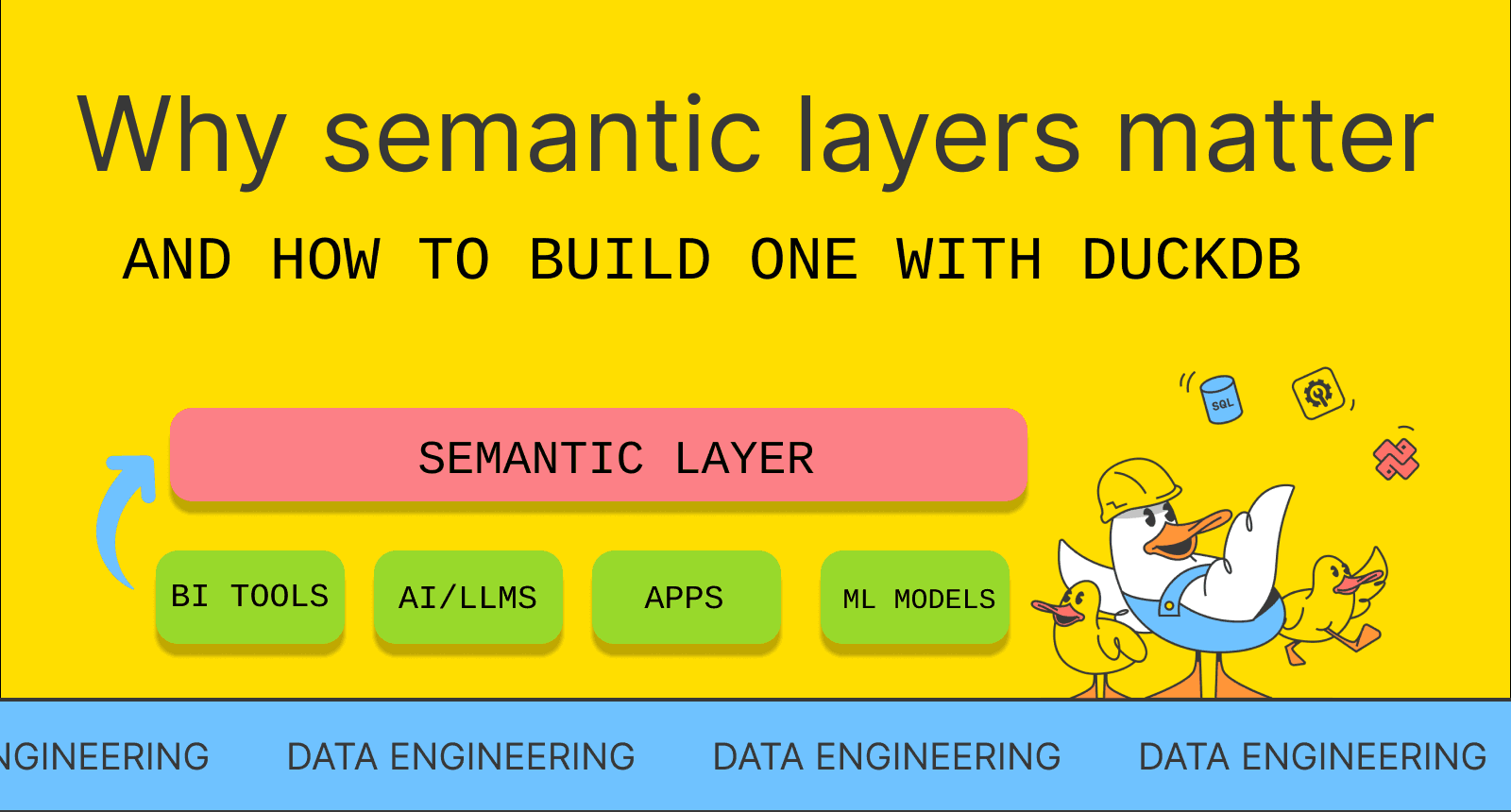
A semantic layer is a layer between raw data and end users that defines business metrics, dimensions, and relationships once, so that different tools and teams query consistent, agreed-upon definitions instead of re-deriving them independently.
A semantic layer sits between the underlying data (tables in a warehouse or query engine) and the people and tools that consume it (BI dashboards, spreadsheets, ad hoc SQL, AI assistants). It defines metrics like "revenue" or "active users" and dimensions like "region" or "plan tier" in one place, along with how they relate to underlying tables, so that every consumer gets the same answer to "what is our revenue this month?" regardless of which tool they used to ask.
Without a semantic layer, the same metric often gets redefined slightly differently in every dashboard and every analyst's query — one dashboard excludes refunds, another doesn't, a third uses a different date field for "month." These small inconsistencies compound into a lack of trust in reported numbers.
revenue = SUM(order_amount) WHERE status != 'refunded')Semantic layers have historically been built into BI tools themselves (like LookML in Looker), but a newer generation of tools — including the dbt Semantic Layer and standalone products like Cube — define metrics independently of any single BI tool, so the same metric definition can be queried from multiple front ends: a dashboard, a notebook, a spreadsheet plugin, or a chat interface.
A semantic layer doesn't replace transformation work — it sits on top of already-modeled tables (often the output of dbt models) and adds a metrics vocabulary. Under the hood, most semantic layers translate a metric request ("monthly revenue by region") into a generated SQL query against the warehouse or query engine, meaning the semantic layer is only as good as the modeled tables it queries.
As more tools and, increasingly, AI agents query data directly, a semantic layer becomes the mechanism that keeps metric definitions consistent across all of them. Instead of every tool or LLM independently guessing how to compute "revenue" from raw tables, they can reference a single governed definition.
Looker is Google Cloud's enterprise BI platform built around LookML, a version-controlled semantic modeling layer that sits between a database and its dashboards.
storage layer →The storage layer refers to the component of a data system responsible for persistently storing and managing data.
Lambda architecture →Lambda architecture is a data processing design that runs a batch layer and a speed layer in parallel to balance completeness and accuracy against low-latency results, merging both into a serving layer.
Rill →Rill is an open-source BI tool built on DuckDB (and optionally ClickHouse) that turns SQL models and YAML metrics definitions into fast, interactive dashboards.
Medallion architecture →Medallion architecture is a data design pattern that organizes a lakehouse into progressive layers — Bronze (raw), Silver (cleaned), and Gold (business-level aggregates) — improving data quality and structure as it moves through each stage.
Conformed dimension →A conformed dimension is a dimension table — like a shared date or customer dimension — that is defined identically and reused across multiple fact tables or data marts, so metrics stay comparable across the warehouse.
A dbt or data model transforms raw data into clean, structured tables. A semantic layer sits a level above that, defining named business metrics and dimensions on top of those tables so that different consumers (dashboards, notebooks, AI tools) query one agreed-upon definition rather than writing their own aggregation logic.
When an AI assistant or natural-language query tool generates SQL on the fly, it risks recomputing metrics inconsistently. A semantic layer gives it a governed set of pre-defined metrics and dimensions to reference instead, reducing the chance of subtly wrong or inconsistent answers.