Today Duck Labs, the developers of DuckDB, announced they are being acquired by Amazon. This is big news in the duck-iverse, and many people are wondering what this will mean for everyone’s favorite duck-powered database.
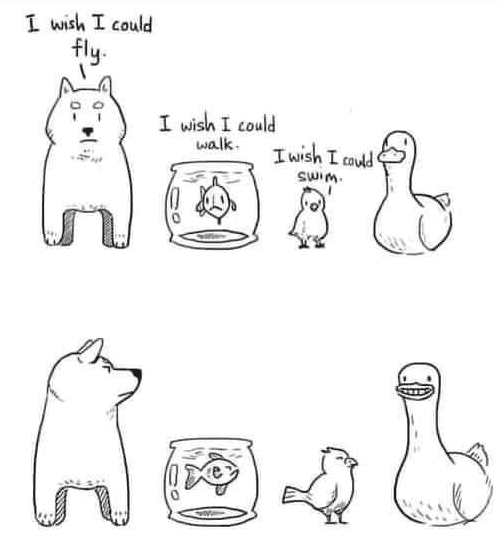
This cartoon has since made the rounds, but I first encountered it when MotherDuck was just a vague idea of starting a company. It illustrates that ducks really are pretty special. Four years later, it is no surprise that Amazon is figuring this out.
The first time I met Hannes and Mark, the DuckDB creators, in April of 2022, they shared that they had already been fending off acquisition offers. One of the reasons they had said no was because they were motivated by more than money; they wanted to build the world’s best database, and being subservient to someone else’s vision would get in the way of that.

Four years later, they’ve built something extraordinary. They’ve demonstrated that a single-node database can outperform the giant distributed databases of the previous decade. They’ve built a large and vibrant community of users that love the product. They’ve preserved their fierce independence and built things their own way, flying in the face of convention and trends.
Success, for DuckDB, was always going to mean that the big companies were going to get involved. It is an inevitable side-effect of success. That’s Amazon’s playbook, after all: wait until an open source project gets big enough, then launch it as a service. This typically serves to propel the project even faster, as it brings distribution, awareness, and standardization.
I believe that this acquisition is being done in a way that is best for the long term prospects of DuckDB as well as the DuckDB community. A rising tide lifts all Ducks, after all. Duck Labs is being kept as a wholly-owned subsidiary, with its organization intact. The Duck Labs team will still be working in open source. The DuckDB Foundation has iron clad control over the DuckDB IP, and DuckDB license is going to stay permissively open.
It is possible that in another couple of years this post will look hopelessly naive, as in “I’m sure that inviting the wolves over for a dinner party will turn out fine.” But even if it is easy to view Amazon as the big, bad wolf dressed up as a bookstore, incentives drive behavior. Amazon is incentivized to have a healthy DuckDB community. While they have DuckLabs as a subsidiary, there is no incentive for them to change the license or close it off; after all, if DuckDB becomes the standard, it is going to drive a lot more compute on their infrastructure, which is where they make their money.
What does this mean for MotherDuck?
MotherDuck was started in partnership with DuckDB Labs. For the last four years we’ve worked closely with Hannes and Mark, and we’ve helped push DuckDB’s growth along to become an amazing database to run as a service. When we started, DuckDB was primarily something that ran on laptops so that people could make sense of their CSV files; you don’t need concurrency or transactions to make that work well.
In the last four years, we at MotherDuck have gotten a lot of experience running DuckDB as a service. Our users run millions of “ducklings” (our term for our serverless DuckDB instances) every week. In order to make this run reliably across the broad cross section of workloads and query patterns our users have, we pushed DuckDB to be more reliable and predictable. We’ve submitted hundreds of patches to DuckDB to fix issues we’ve encountered. We’ve also built and operationalized a service that runs very well; in an age where you can vibe-code more and more things, you still can’t generate reliable infrastructure from a prompt.
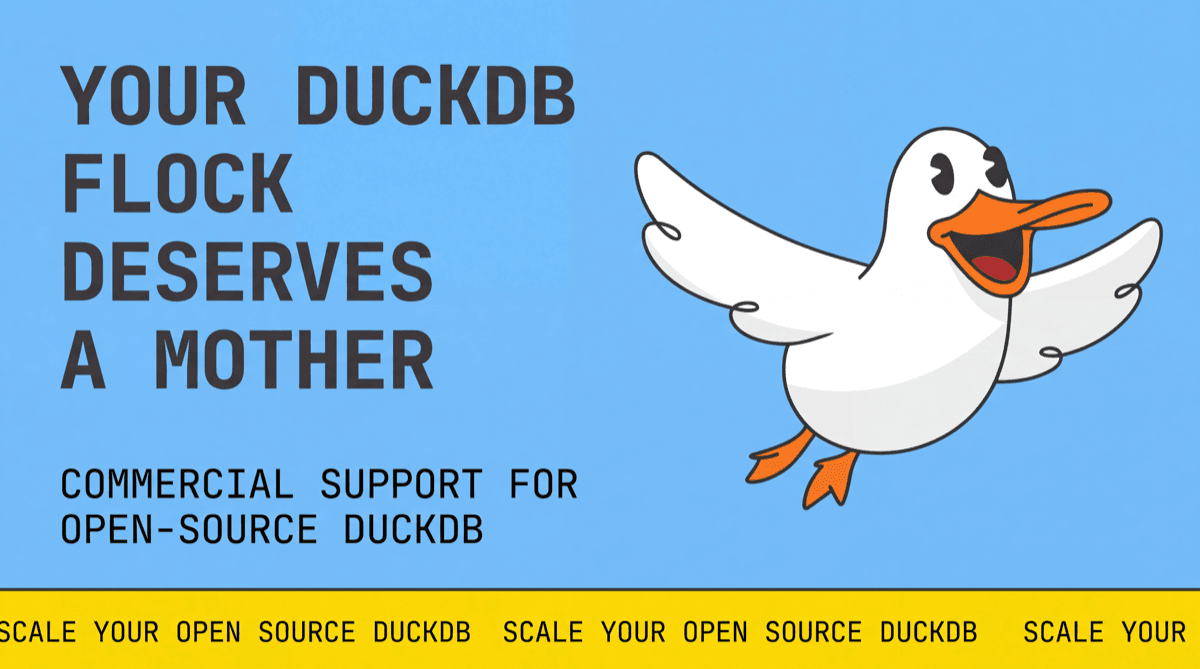
MotherDuck now offers enterprise support, allowing us to share our hard-won expertise at running production DuckDB at scale. We had avoided this in the past because we didn’t want to compete with Duck Labs, who relied on this as their business model. Now that they are joining Amazon, we have the explicit blessing from Hannes and Mark that this won’t be stepping on their toes. We also think that in the aftermath of the acquisition more people are going to be building with DuckDB, and we’re here to help. Reach out here if you’re interested.
Some day, Amazon will likely release their own service based on DuckDB. After all, they’re not acquiring Duck Labs just because they love open source. We agree that DuckDB is a great engine for building a cloud data warehouse, and appreciate that Amazon sees that too. We welcome the competition.
Earlier in my career I worked on Google BigQuery during the Cloud Data Warehouse wars between Snowflake, BigQuery, and Amazon Redshift. The presence of Redshift on AWS didn’t slow down Snowflake’s growth, even on AWS. Competition between those three products was ultimately good for users; it pushed each one of them to get better. We have high confidence that whatever Amazon will build will be different enough for both their product and our MotherDuck to be successful. And what we learn from each other will lead to better experiences for our customers.
I caught up with Peter Boncz, who leads the databases group at CWI in Amsterdam and is a member of the DuckDB Foundation board, to talk about the acquisition. He is also a research collaborator with MotherDuck. He reiterated the job of the Foundation, as owner of the DuckDB IP, to preserve the open-source nature of DuckDB. He also expressed that he was happy to see AWS’s commitment to advancing open source DuckDB. Further, he shared that “this work will continue and I know MotherDuck will continue to contribute to open-source DuckDB.”
MotherDuck will continue working closely with Duck Labs engineers and continue to help improve DuckDB. Three of our engineers are among the top 10 external contributors to DuckDB. In the future, we’ll be doing even more work on making DuckDB better, both to help MotherDuck and the community. In order to expand these abilities, we’re growing our database team. If you want to work on DuckDB, please reach out, we’re hiring!
Duck Labs is growing up and leaving the nest. This is a natural and needed step. MotherDuck, true to our name, is both proud of the moment and a little bit nervous about what they’ll get up to next. We have no doubt that DuckDB will fly far, and we are excited to continue to be a big part of DuckDB's future, as DuckDB will remain a big part of ours.
If you want to give cloud-hosted DuckDB a try, you can sign up for free here.