What makes a great Dive? What DiveMaxxing taught us
- 5 min read
What do you build when the only limit is what you can describe?
Someone built a map of every US county that recolors to your own idea of home. You can drag sliders for affordability, schools, clean air, walkability, and it finds which counties on a map match it best.
Someone else turned running a logistics company into a game. Twelve turns (quarters), adversarial order data, and a leaderboard you're trying to stay off the bottom of. As a bonus - all built from a phone.
Neither of these started in a code editor. The builder described what they wanted to an AI agent, and it built the thing. That's a Dive: an interactive data app that runs live SQL against your data, built by your AI agent.
All of this came out of DiveMaxxing, a three-week competition we ran: build a Dive, publish it to the gallery, and the best ones win a duckified Mac Mini. 48 people entered. They built 60 Dives, and the range floored us.
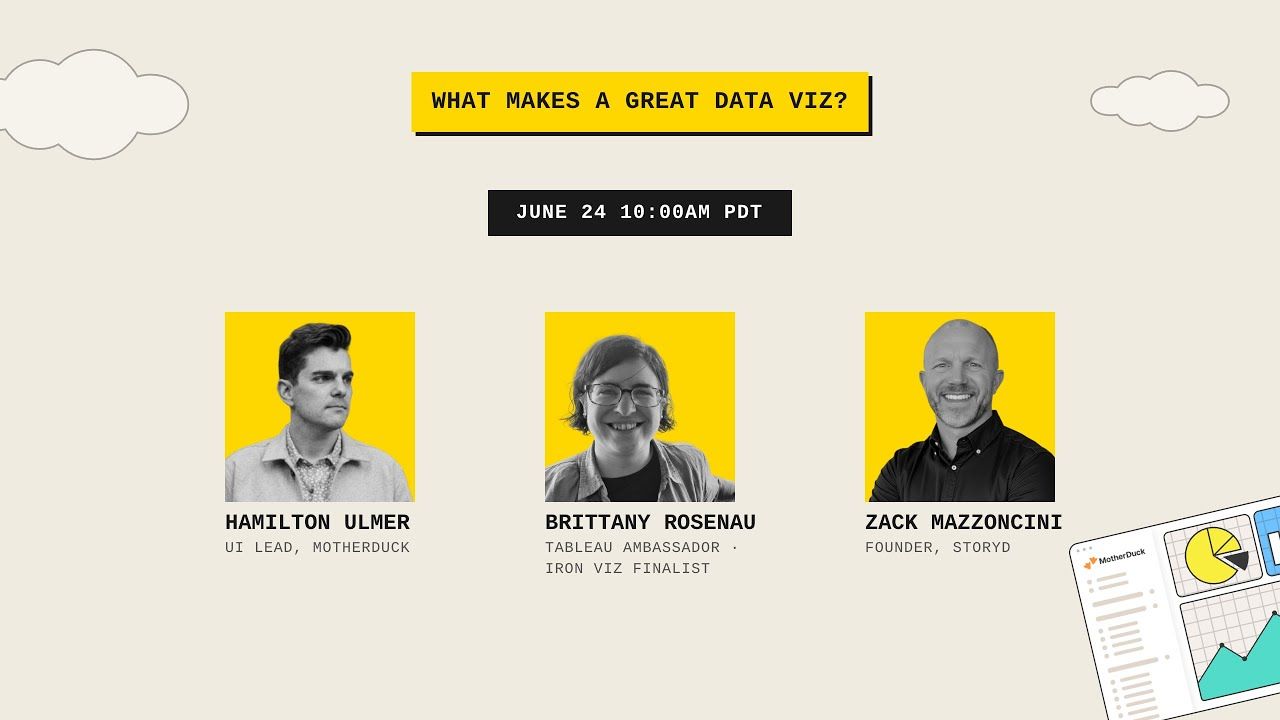
We capped it off with a live panel where three judges picked the winners: Hamilton Ulmer, our UI lead and the tech lead on Dives; Brittany Rosenau, a Tableau Ambassador and Iron Viz finalist; and Zack Mazzoncini, founder of Data Story Academy. Here's who won, and a tour of the gallery they came from.
Best Overall: "Who Powers AI?"
Darragh Murray's Dive could be a New York Times interactive. It's data journalism about the companies and infrastructure behind AI, and the charts serve the story as a primary goal. Zack, our narrative guy, said you know what it's about in three words - the title gives it away. Brittany liked that it's a choose-your-own-adventure: for every bubble you clicked, the story evolved for that specific side of the story.
From Hamilton: "I just started reading and I didn't stop till I got to the bottom, because it was so engaging. It almost anticipated all the questions I wanted to ask." That is an icredibly high bar - so good that it answered the questions before they could be asked.
Most Creative: "Business Graph Explorer"
Salo Vaisberg's Dive opens as a plain diagram and keeps unfolding. Underneath, it's an entity graph of a business: the schemas and objects you'd recognize if you knew the company. Click in and it layers analytics right onto the relationships. Brittany said she'd want it sitting on top of every data model she owns. Hamilton loved the small touches, like "little bars underneath numbers, so my eyes can just quickly smell magnitudes of things."
When we clicked through it live, Brittany put her finger on why it won: "Every click does exactly what you think it will do." Building that type of intuitive UI requires deep empathy and understanding of your users - incredibly well done.
Community Favorite: "Supply Chain Command Center"
Dharma Palepu's Dive took the community vote, and its standout feature is the theming: six color modes on top of a traditional take on business metrics. Brittany made the case for why that's more than a flourish: switching modes is slow to build in traditional tools, and it's how you design for accessibility.
It's a polished operational dashboard that knows what it is, and it earned the votes. It also had an awesome feature that walked you through the insights within it.
The rest of the gallery
Three winners took the podium, but the reason the gallery is worthy of spending some time poking around, too. There's a time machine for music, a game built around a growing family of AI agents, a "Butterfly Effect" sim for rewriting human history, a financial briefing book, a even more. Three that stood out to us:
- A Home Fit For You pulls 10 federal datasets and lets you weight what you actually care about, with two sliders for the soft stuff: cold versus warm, small town versus big city. The county map recolors as you change parameters on the fly, and clicking one gives you a plain-language breakdown of the region. Genuinely useful!
- DuckDash is a business sim. Run a logistics company over twelve quarters against "real order data that fights back," pulling six levers, marketing to surge pricing, to stay off the bottom of the leaderboard. As a bonus: Built on a phone, for the phone.
- DuckDoom is a pure stunt. It's DOOM, except the engine is SQL. Every frame casts 160 rays against a walls table, projects the enemy sprites, runs chase AI that respects line-of-sight, and resolves your shots. The React side is just a thin client: canvas, minimap, HUD, and the E1M1 theme through the Web Audio API. It's honestly a small miracle it runs at all. The author may not have won but fairplay to you, sir!
As a reminder, a Dive is just React and SQL on top of your data. As Hamilton put it, that means "you have access to everything you can do in a browser." Not just dashboards. Anything that lives on your data. When we launched Dives, the example list we shared ended with "Doom! (yes, of course)" as a half-joke. Steven made it real. Point an agent at an idea, and everything else is one prompt away.
Go make one
We shipped Dives in February expecting people to use them for a couple of graphs, something stuck between a Jupyter notebook and a BI tool and not great at either. As Hamilton said in the livestream - "I couldn't have been more wrong." The way he frames it now: a Dive is "a dwelling," and people rearrange the furniture however they want. Sixty rooms later, that's exactly what the gallery looks like.
I'll give Brittany the send-off, because it's the right note: "Make vizzes about stuff you care about and put it out there. There's so much you can learn just by creating these little passion projects."
A Dive is a shareable visualization your AI agent builds, live on your data. Browse the gallery, watch the full judges' panel, and go make one.
Table of contents