
BLOG
Two distinct movements are reshaping data engineering. Traditional tools add AI features to existing workflows, an incremental improvement. Simultaneously, a new paradigm is emerging where AI agents build and operate pipelines themselves, a structural shift.
This article distinguishes between "AI-assisted ETL" and the new category of "agent-native data ingestion," defines both, and identifies the unified infrastructure required to make agent-native workflows possible. It also provides a concrete walkthrough for building your first agent-native pipeline using MotherDuck Flights and a Model Context Protocol connected agent.
AI-assisted ETL layers artificial intelligence features onto traditional data workflows where a human remains the primary author and operator. The AI acts as a copilot that suggests optimizations and generates code snippets, but it does not own the end-to-end process. The goal is to reduce friction for the human engineer while maintaining their direct control.
Traditional ETL pipelines execute fixed, deterministic steps: extract from a source, transform per predefined rules, and load into a target. In an AI-assisted model, the human engineer still defines this Directed Acyclic Graph.
Common features in this category include:
These tools accelerate development but share a common limitation: the process still requires a human engineer to design the pipeline, manage its schedule, and intervene when it fails. The AI accelerates the human's work, but the human engineer remains in control. Platforms ranging from GitHub Copilot and Informatica CLAIRE to Snowflake (Cortex AI) and Databricks (copilot features) all operate primarily in this AI-assisted capacity.
Agent-native ingestion enables an AI agent to build and schedule a data ingestion pipeline with no human writing the implementation. The agent receives a description of the source and destination, generates the extraction code, deploys the code as a scheduled job, and manages credentials through a single control plane.
While the authoring of the pipeline is agentic and stochastic, the actual execution of the deployed Flight remains completely deterministic.
The human's role transitions from authoring code to describing goals and reviewing the agent's output. The agent takes on implementation, while the human provides oversight and final approval. This maps to the broader spectrum of agentic autonomy: the agent decides what data to fetch, how to transform it, and when to refresh it based on a goal specification.
This table breaks down the core differences:
| AI-assisted ETL | Agent-native ingestion | |
|---|---|---|
| Who builds the pipeline? | Human (with AI suggestions) | Agent (with human review) |
| Who deploys it? | Human | Agent |
| Who schedules it? | Human (or vendor) | Agent |
| Who manages credentials? | Human or vendor | Runtime (warehouse-managed) |
| What AI does | Suggests, flags, generates snippets | Authors, deploys, operates |
| Interface for agent | None (pipeline lives in a vendor's UI) | MCP server, a unified control plane |
| Example | Snowflake Cortex AI with automated schema drift handling | MotherDuck Flights via MCP |
| Ideal Infrastructure | Fragmented legacy stack (separate orchestrator, warehouse, ETL tool) | Modern cloud data warehouse (unified data, compute, and secrets) |
An AI agent cannot operate effectively on a legacy, fragmented data stack. Managing separate APIs and credential boundaries for an ETL tool (like Fivetran), an orchestrator (like Airflow), a secrets manager (like AWS Secrets Manager), and a warehouse (like Snowflake) creates a coordination burden that makes reliable agent operation fragile. When an agent must track state and manage tooling across multiple system boundaries to deploy a single script, it loses context between steps and generates incorrect tool calls that cascade into pipeline failures.
Agent-native ingestion requires a single control plane, a unified architectural surface where the agent can manage all necessary components of a data pipeline through one consistent interface. To be effective, this control plane must give the agent access to:
Through its native MCP server, an AI agent gains access to the entire data lifecycle in MotherDuck. The agent can use MotherDuck Flights, serverless Python compute, to build and run data pipelines within the same environment where the data lives. This eliminates the multi-tool complexity that causes agentic workflows to fail on fragmented stacks.
Agent-native ingestion is a core component of a modern, unified data platform. Within MotherDuck, Flights, Dives, and the MCP server work together across the full pipeline from ingest to insight.
Flights handle ingestion and transformation as a reusable compute primitive. The same primitive that runs your ingestion pipeline can also run transforms, backfills, and scheduled maintenance jobs, so teams do not need to introduce a separate tool for each category of scheduled work. Dives, MotherDuck's built-in visualization layer, let you explore and visualize the ingested data natively. The MCP server connects both: a single agent can manage data movement through Flights and data analysis through Dives in one continuous conversation, taking a source description to a working dashboard without leaving the chat thread.
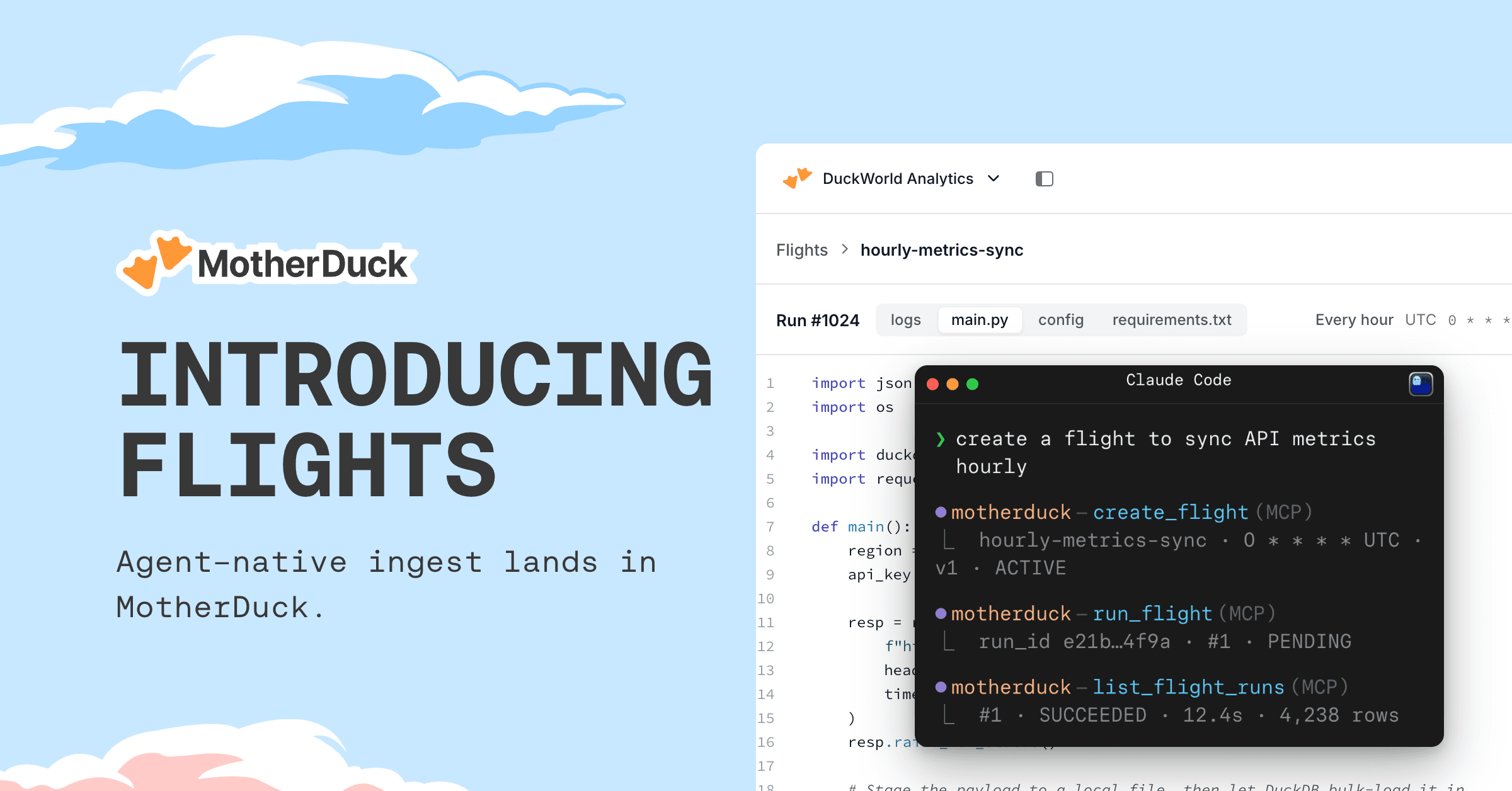
This walkthrough demonstrates how an AI agent can build a production-ready, micro-batch ingestion pipeline using MotherDuck Flights and the Model Context Protocol (MCP). The agent writes standard Python code, often using dlt (a lightweight Python ingestion library that handles schema evolution and incremental loading) to manage schema drift, and deploys it as a scheduled job.
Connect your agent to the MotherDuck MCP server. Connect any MCP-capable agent (Claude, Cursor, or similar) to the MotherDuck MCP server and the agent gets the full Flights surface as tools: create, run, schedule, update, inspect logs, version, delete. It also gets get_flight_guide, a built-in instruction set, so the same prompt produces a working Flight whether it's the agent's first or hundredth. Secrets stay in MotherDuck and are injected into the Flight at runtime; your agent never sees them.
Describe the source. Provide the agent with a natural language prompt describing the ingestion task. For example: "Pull daily transaction records from our Stripe API and load them into the 'payments' table in MotherDuck. The pipeline should run every day at 6am UTC."
The agent writes the extraction code. The agent generates a Python function to handle the entire pipeline logic. This includes authenticating with the Stripe API, handling pagination to fetch all records, performing any necessary micro-transformations, and loading the data into the target MotherDuck table. Because Flights support any pip-installable package, the agent will typically use dlt to handle incremental loading and schema drift.
The agent deploys it as a Flight. Using its MCP connection, the agent calls the MCP tool (or the MD_CREATE_FLIGHT SQL table function) to deploy the Python function. MotherDuck automatically provisions the necessary isolated compute, stores the code, versions it, and registers the schedule you specified.
The agent configures credentials. The agent references the pre-configured Stripe API key by name from MotherDuck's secure credential store. The Flight code injects this credential at runtime. The raw API key never appears in the code, its value is never exposed to the agent, and it is not stored in version control.
It runs. You review. The Flight executes automatically on its schedule, or the agent can trigger it immediately via MCP tool (or MD_RUN_FLIGHT). You can monitor run histories, view row counts, and inspect failure logs directly in the MotherDuck UI or by asking the agent through the MCP interface. Agents operate under bounded autonomy: a human reviewer checks run histories, row counts, and logic updates before changes go to production.
Agent-native ingestion excels at eliminating the boilerplate of routine pipeline development, but it requires a framework of bounded autonomy. It augments the capabilities of experienced data engineers.
Works well when:
Needs human oversight when:
The evolution of AI in data engineering changes the pipeline author from a human to an AI agent. This shift from AI-assisted to agent-native requires infrastructure built around a unified control plane. By providing this surface natively with its MCP server and Flights compute, MotherDuck enables data teams to use AI as a true author and operator, reducing pipeline development from days to hours.
Ready to build your first agent-native pipeline? Connect your agent to MotherDuck and start a free trial.
Start using MotherDuck now!
In AI-assisted ETL, human engineers write and deploy the code while AI acts as a copilot offering suggestions and snippets. In agent-native ingestion, an autonomous AI agent writes, deploys, and schedules the pipeline itself within a unified control plane. The human's role shifts from implementation to oversight and review.
No. It reduces the implementation overhead for routine pipeline work. Data engineers still design the architecture, review agent-generated code, handle edge cases, and make decisions about data modeling and reliability. The agent handles the repetitive parts of writing standard extraction and loading logic.
A Model Context Protocol (MCP) server is a unified control plane that gives AI agents access to your data, compute, and secrets. Legacy, fragmented stacks require agents to manage multiple separate APIs and credential boundaries, which causes context loss and incorrect tool calls. The MotherDuck MCP server consolidates data access, Flights compute, scheduling, and run history into a single interface for the agent.
With the right infrastructure, yes. Using MotherDuck Flights via an MCP connection, the agent generates extraction code, provisions isolated serverless Python compute, and registers a recurring schedule. While pipeline authoring is agentic, the actual execution of the deployed job is completely deterministic. Production workloads should still involve human review of agent-generated code before deployment.
Any source that is Python-scriptable: REST APIs, databases, cloud storage, webhooks, and file systems. The agent typically uses dlt to manage incremental loading and schema drift. Sources with bespoke, multi-step authentication flows or heavy streaming architectures still require manual engineering.
When an agent deploys a pipeline, it references a pre-configured API key by name from the warehouse's secure credential store. The raw keys are never placed in version control and are never visible to the Large Language Model. The Flight runtime injects the credential at execution time.
Engineers review run logs and row counts in the MotherDuck UI or via the MCP interface, then correct the pipeline before changes go to production. Agentic workflows operate under bounded autonomy: a human reviewer always checks run histories and logic updates before changes are applied.