BLOG
Less than three weeks before Data Outpost. Get your ticket before they sell out.Join AI and Data builders Nov 4-5 in SF
A table format is a metadata layer on top of data files in a lake or object storage that defines what constitutes a table — its schema, partitioning, and file list — enabling ACID transactions, schema evolution, and time travel across multiple query engines.
A table format sits between raw file formats (Parquet, ORC, Avro) and the query engines that read them. A file format defines how bytes are laid out inside a single file; a table format defines how many files, potentially spread across a whole directory tree, together constitute one logical, evolving table — including its current schema, partitioning scheme, and the exact set of files that make up any given version.
Without a table format, a "table" on a data lake is just a directory of files, discovered by listing that directory — the approach Hive originally used. That makes concurrent writes unsafe, schema changes destructive, and there's no way to see a consistent snapshot while a write is in progress. A table format solves this with explicit metadata: a chain of files (or, in DuckLake's case, rows in a SQL database) that record every data file, its schema version, and a full history of snapshots, giving:
_delta_log) alongside Parquet data.DuckDB has extensions for the major open table formats, so the same engine can query tables regardless of which format wrote them:
Copy code
LOAD iceberg;
SELECT * FROM iceberg_scan('s3://bucket/warehouse/orders');
LOAD delta;
SELECT * FROM delta_scan('s3://bucket/warehouse/customers');
ATTACH 'ducklake:metadata.ducklake' AS lake (DATA_PATH 's3://bucket/data/');
SELECT * FROM lake.events;
Schema evolution is the ability to change a table's structure — adding, removing, renaming, or reordering columns, or widening types — over time without needing to rewrite all existing data or break existing readers.
Apache Iceberg →Apache Iceberg is an open table format that adds ACID transactions, schema evolution, and time travel to large analytic tables stored as files in a data lake.
Data lakehouse →A data lakehouse is an architecture that combines the low-cost, flexible storage of a data lake with the ACID transactions, schema enforcement, and performance features of a data warehouse.
Delta Lake →Delta Lake is an open table format, originally developed by Databricks, that adds ACID transactions, schema enforcement, and time travel to Parquet data stored in a data lake.
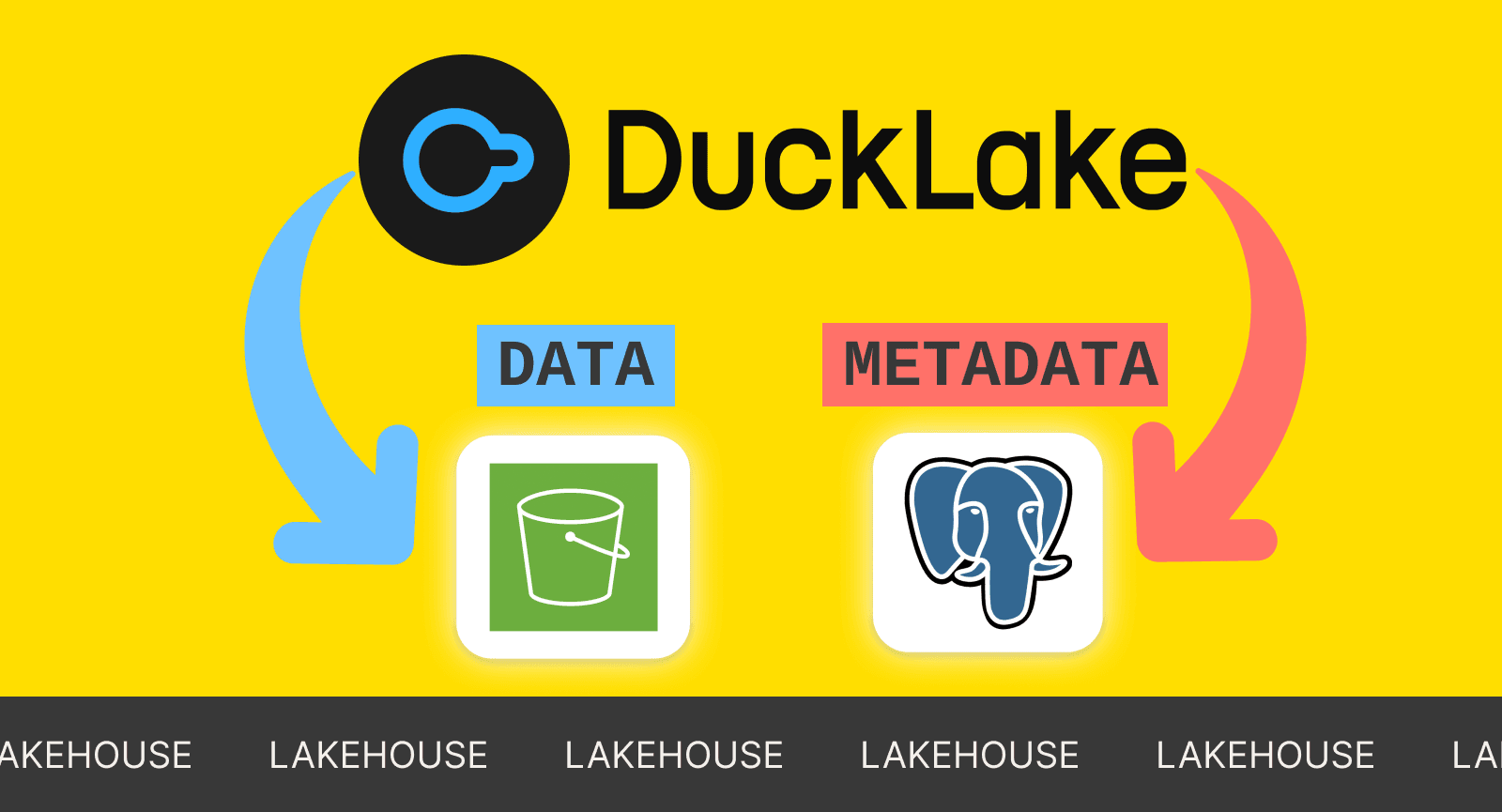
DuckLake →DuckLake is an open table format, created by the DuckDB team, that stores lakehouse metadata in a transactional SQL database instead of files — while keeping the actual data as Parquet files in object storage.
Data lake →A data lake is a centralized repository that stores raw structured, semi-structured, and unstructured data at any scale, in its native format, until it's needed for analysis.
A file format (like Parquet or ORC) defines the byte layout of a single file. A table format (like Iceberg, Delta Lake, or DuckLake) defines how a collection of those files together forms one logical, versioned table, adding transactions, schema evolution, and time travel.
The most widely used are Apache Iceberg, Delta Lake, and Apache Hudi, which all store metadata as files alongside the data. DuckLake is a newer format that stores the same kind of metadata in a SQL database instead.
Yes, as long as the engine has support for each format. DuckDB, for example, has separate extensions for Iceberg, Delta Lake, and DuckLake, so it can query tables written by different tools without converting them.