BLOG
Less than three weeks before Data Outpost. Get your ticket before they sell out.Join AI and Data builders Nov 4-5 in SF
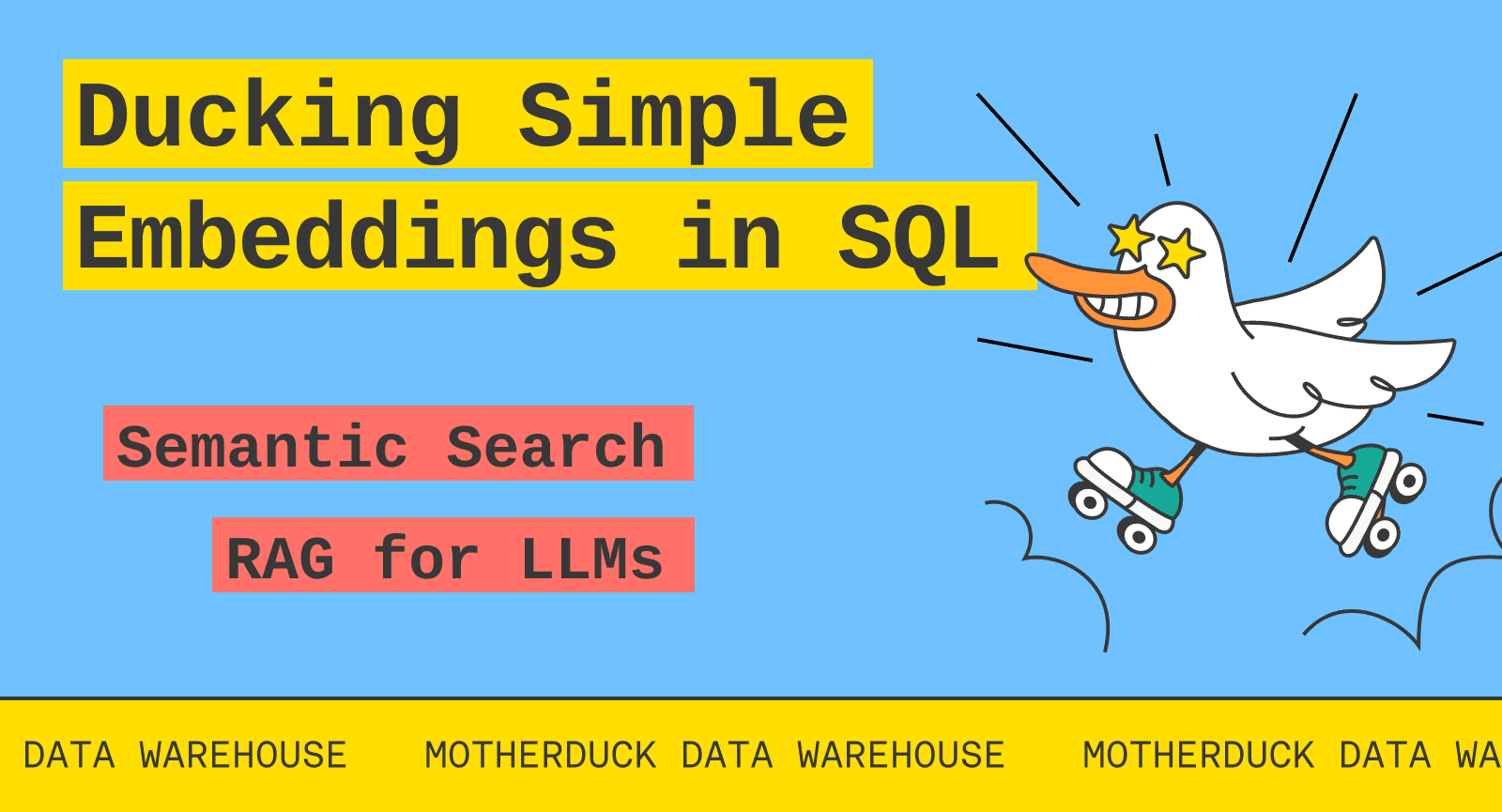
Embeddings are dense numeric vector representations of data — text, images, audio, or other objects — learned so that semantically similar inputs end up close together in vector space.
An embedding is a fixed-length vector of floating-point numbers produced by a machine learning model to represent a piece of data, such as a word, sentence, document, or image. The key property that makes embeddings useful is that geometric distance in the vector space tracks semantic similarity in the original domain: two sentences with similar meaning should produce embeddings that are close together (by cosine similarity or Euclidean distance), even if they share few literal words. Models like OpenAI's text-embedding-3, Cohere's embedding models, and open-source options such as those from the sentence-transformers family are commonly used to generate them.
Embeddings are the foundation of several practical techniques: semantic search (finding documents by meaning rather than exact keyword match), recommendation systems (finding similar items or users), clustering and deduplication, classification via nearest-neighbor lookup, and retrieval-augmented generation (RAG), where relevant text chunks are retrieved by embedding similarity and provided as context to a language model.
DuckDB can store embeddings as a fixed-size ARRAY column and search them with the vss extension, which adds HNSW indexing and distance functions.
Copy code
INSTALL vss;
LOAD vss;
CREATE TABLE chunks (
id INTEGER,
text VARCHAR,
embedding FLOAT[1536]
);
-- find the 5 most similar chunks to a query embedding
SELECT id, text
FROM chunks
ORDER BY array_distance(embedding, ?::FLOAT[1536])
LIMIT 5;
This lets an application keep raw text, metadata, and embeddings together in one place and combine similarity search with ordinary SQL filtering — for example, restricting a similarity search to documents from a specific date range or category in the same query.
A vector database stores high-dimensional numeric vectors (typically embeddings) and provides fast similarity search over them, powering use cases like semantic search and retrieval-augmented generation.
Lance format →Lance is a modern, open-source columnar file format designed for machine learning and vector-search workloads, offering fast random access, versioning, and native support for embeddings alongside tabular data.
Full-text search →Full-text search is a technique for searching text content by relevance to a query — matching keywords, handling stemming and ranking results — rather than requiring an exact substring or equality match.
LIST and ARRAY type →LIST and ARRAY are nested SQL data types for storing an ordered collection of values in a single column — LIST is variable-length, ARRAY is fixed-length.
It depends on the model — common sizes range from a few hundred to a few thousand dimensions (for example, 384, 768, or 1536), and the dimensionality is fixed by whichever embedding model produced the vector.
Yes. Storing embeddings alongside other columns in a database like DuckDB lets you combine a similarity ORDER BY with standard WHERE clauses, joins, and aggregations in a single query, rather than running vector search and metadata filtering as separate steps.